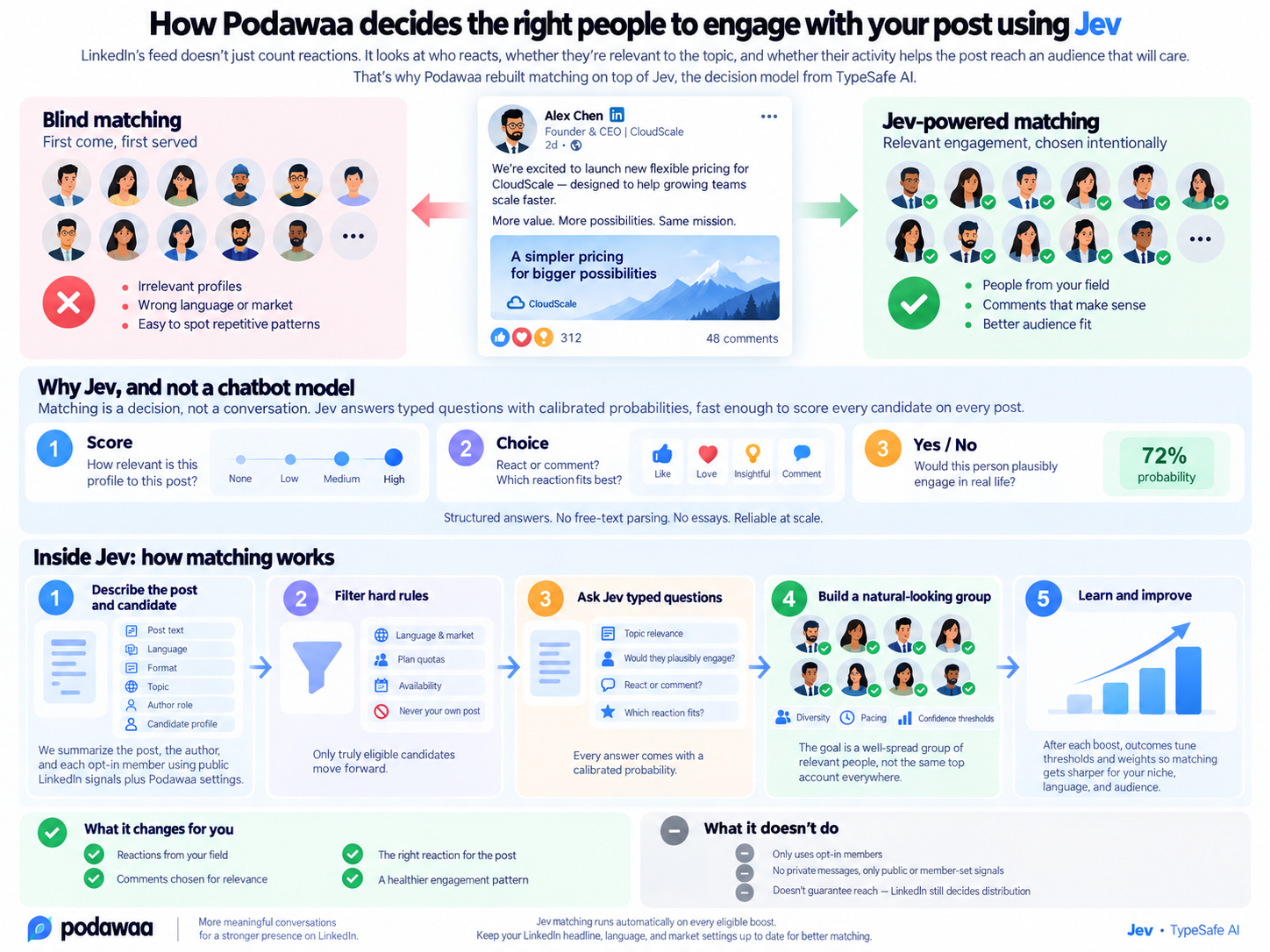
LinkedIn's feed doesn't just count reactions. It looks at who reacts, whether those people are relevant to the topic, and whether their activity spreads the post to an audience that will care. Engagement from the wrong profiles can do nothing at all. In the worst case it teaches the algorithm that your post belongs in the wrong feeds.
That's why we rebuilt how Podawaa decides who engages with each post, on top of Jev, the decision model from TypeSafe AI.
The problem with "first come, first served"
Most engagement tools fill a post from whoever is available. It's fast and simple. It's also blind:
- A SaaS founder's post about pricing gets reactions from recruiters, photographers and students.
- A French-language post gets comments from people who don't read French.
- The same small group of accounts keeps showing up on the same authors, and that pattern is easy to spot.
Volume goes up and relevance goes down. We wanted the opposite.
Why Jev, and not a chatbot model
Matching is a decision, not a conversation. For every post we need to answer the same question hundreds of times: does this person belong under this post?
A general-purpose language model answers in free text. We'd have to parse it, it can wander off-format, and it's slow and expensive at that volume.
Jev works differently. You give it a situation and a typed question, and it returns a typed answer with a calibrated probability. It never returns an essay. Three kinds of question cover everything we need:
- Score: rate something on a fixed scale ("how relevant is this profile to this post: none, low, medium, high?").
- Choice: pick one option from a defined list ("which reaction fits best?").
- Yes/no: a direct decision with a probability ("would this person plausibly comment on this?").
Because answers always follow the schema we define, there's nothing to parse and nothing to hallucinate. Because it's built for speed, we can ask for every candidate on every post.
Step 1: describing the post and the candidate
For each post, we build a compact description of the situation:
- The post: its text, language, format (text, image, carousel, video) and topic.
- The author: headline, role, industry and market.
- Each candidate engager (members who have opted in): headline, current role, industry, seniority, the topics they post about, the languages they use and the region they're active in.
We only use what LinkedIn already makes public, plus the settings members choose in Podawaa.
Step 2: filtering on hard rules
Before asking Jev anything, we apply the rules that should never depend on a model: language and market, plan quotas, availability, and never engaging on your own post. Jev only sees candidates who are actually eligible.
Step 3: asking Jev the right questions
For every eligible candidate, Jev answers a short set of typed questions about the post:
- How relevant is this profile to this post's topic? (Score): the core of the ranking.
- Would this person plausibly engage with this post in real life? (Yes/no): filters out unnatural matches.
- Is this person better suited to react or to comment? (Choice): picks the right type of engagement.
- Which reaction fits the post best? (Choice): chooses between Like, Insightful, Celebrate…
Each answer comes with a probability. That's what makes the system reliable: when Jev is unsure, we know it, and we don't treat an uncertain match like a confident one.
Step 4: building a natural-looking group
The best result isn't the single top-scored profile repeated everywhere. It's a well-spread group of relevant people who look like a real audience. So the final selection combines Jev's calibrated scores with:
- Diversity: the same accounts don't keep landing on the same author.
- Pacing: engagement arrives at a natural pace, not in one burst.
- Confidence thresholds: a low-confidence match only comes in when better options have run out.
Step 5: learning from what actually happens
After each boost, we compare Jev's predictions with what happened: how far the post travelled and which engagements started real conversations. That feedback tunes our thresholds and weights, so matching gets sharper for your topics, your language and your audience.
What it changes for you
- Reactions from your field. Your post is seen by people in your industry, and so is the engagement on it.
- Comments that make sense. Commenters are picked because they're relevant to your topic.
- The right reactions. A product launch gets celebrated, a deep analysis gets marked insightful.
- A healthier engagement pattern. Diversity and pacing make your activity look like what it should be: interest from a relevant audience.
[TODO after launch: add 1–2 measured results with the numerator, denominator and time window, e.g. "share of engagements from the author's industry, before vs after Jev, over N posts in [period]". Leave this block out if the data isn't there yet.]
What it doesn't do
We want to be clear about where the line is:
- Matching only uses members who have opted in to Podawaa, and only signals that are public or that they've set themselves.
- It doesn't read private messages and doesn't collect data beyond what matching needs.
- It doesn't guarantee reach. It improves who engages, and LinkedIn still decides how far a post goes.
Getting started
There's nothing to set up. Jev matching runs on every boost as soon as it's available on your plan. To help it match you better, make sure your LinkedIn headline and your channel's language and market settings in Podawaa are up to date.