Short answer: in our data, the em dash (—) is not punished on LinkedIn. For the same author, posts that contain one get 9% more reactions. Words that "sound like AI" show no penalty either. What really moves the numbers is length: posts between 1,300 and 2,000 characters get 65% more reactions than the same author's short posts.
The claim: "the em dash gives away your AI"
Since AI writing tools went mainstream, a rule has spread across LinkedIn: the em dash is a ChatGPT tell, readers spot it, and LinkedIn quietly buries your post. People now search-and-replace every dash before publishing.
We checked it against real posts.
What 26,612 posts with an em dash show
Out of 232,606 posts published over the last 12 months by 9,382 authors, 26,612 contain at least one em dash.
To avoid comparing big accounts with small ones, we compared each author to themselves: every post's reactions divided by that author's median (authors with at least 10 posts). A score of 1.00 is a normal post for that person.
| Feature | With | Without | Difference |
|---|---|---|---|
| Em dash (—) | 1.00 | 0.92 | +9% |
| "AI words" (leverage, game-changer, unlock, delve…) | 1.04 | 0.93 | no penalty |
Not fewer reactions. More. We are not saying the em dash causes extra reactions: people who write longer, more structured posts probably use it more. But there is no sign of a penalty.
What really moves the numbers: length
When we grouped the same posts by length, the gap was far bigger than anything punctuation or vocabulary produced.
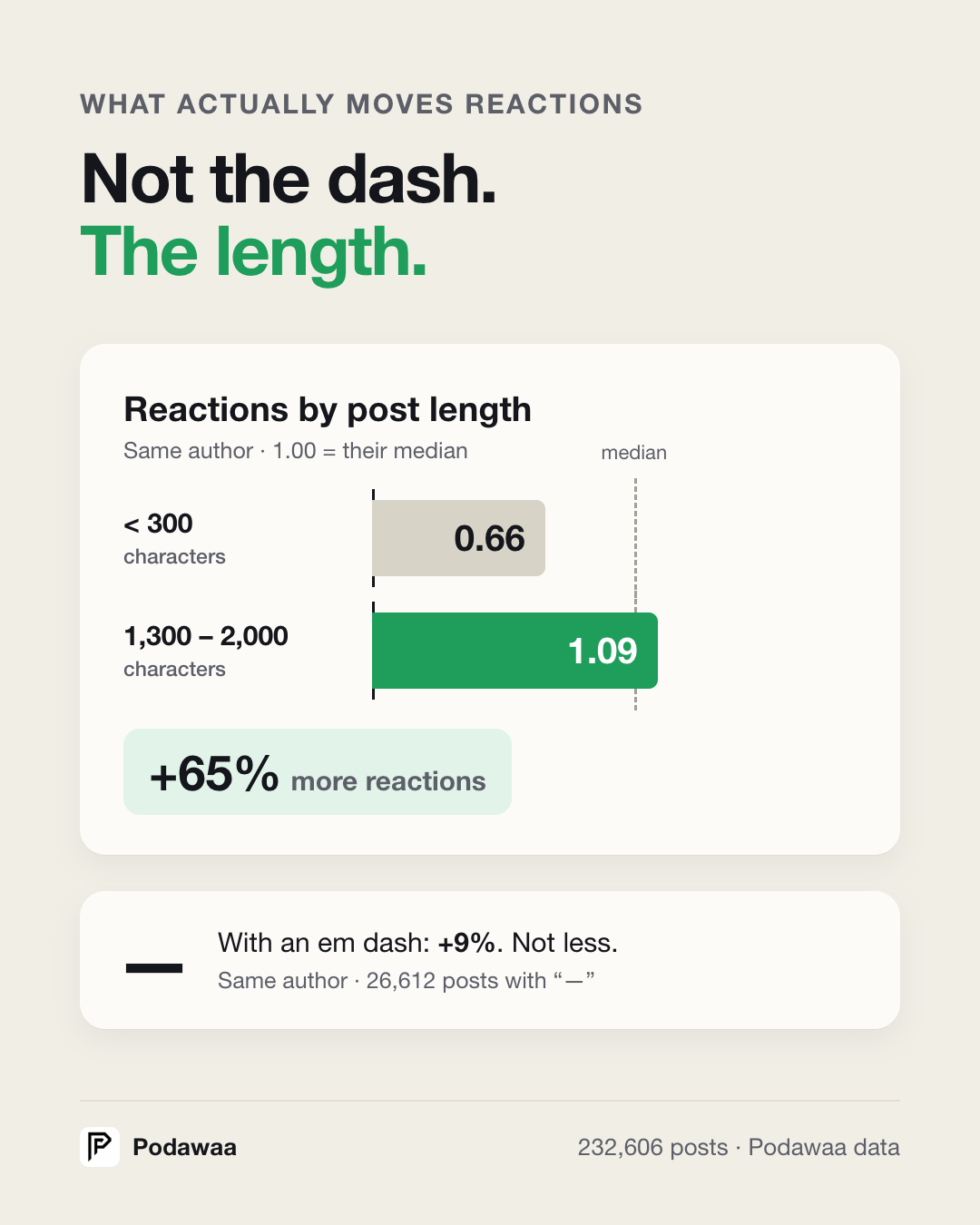
- Under 300 characters: 0.66 (a third below the author's usual level)
- 1,300 to 2,000 characters: 1.09
That is 65% more reactions for the same person when they write a developed post instead of a one-liner. For reference, this paragraph and the two before it are about 600 characters.
What this means for your writing
- Stop hunting dashes. Write the way you write. If your post reads like a person thinking, the punctuation does not matter.
- Do not fear certain words. "Leverage" will not sink your post. Empty posts will.
- Write long enough to say something. Aim for a post that makes one clear point, with an example or a story: that usually lands between 1,300 and 2,000 characters.
- Check before you publish. The free LinkedIn post checker counts characters and flags weak hooks. For structure, see how to write better LinkedIn posts.
The other myths we tested
The same dataset debunks another popular rule: hashtags do not cut your reach once each author is compared to themselves. And on the engagement side, posts that ask for comments get 30% more of them.
How Podawaa helps
A strong 1,500-character post still needs to be seen. Podawaa puts a fresh post in front of relevant professionals in its first hour, so good writing gets a fair start. It does not guarantee reach, and it does not replace a good post. The Free plan includes 5 boosts per month with no card; paid plans start at €29/month. Try it free.
FAQ
Does LinkedIn penalize the em dash?
Not in our data. For the same author, posts with an em dash get 9% more reactions than posts without (1.00 vs 0.92 relative to the author's median), measured on 26,612 posts.
Does LinkedIn detect and penalize AI-written posts?
We cannot see LinkedIn's systems, but we found no penalty for words commonly associated with AI writing (leverage, game-changer, unlock, delve): 1.04 vs 0.93.
What is the best length for a LinkedIn post?
In our data, posts between 1,300 and 2,000 characters perform best: 65% more reactions than the same author's posts under 300 characters.
How was this measured?
232,606 posts by 9,382 authors over 12 months, boosted posts excluded. For authors with at least 10 posts, each post's reactions were divided by the author's median, then averaged (geometric mean) by group.
Source: Podawaa database, 232,606 LinkedIn posts published between October 2025 and October 2026 by 9,382 authors, boosted posts excluded; extracted October 12, 2026. These are correlations observed in our data, not a description of LinkedIn's ranking system.