
Short answer: most LinkedIn comments are short and generic. One in five is under 20 characters, and the No. 1 comment by far is "Congratulations". Right behind it are single keywords like "Claude" or "prompt", typed to receive a guide. Comments are rare (1 for every 9 reactions), and posts that explicitly ask for one get 30% more.
What we analyzed
We looked at 503,711 comments received on LinkedIn posts over the last 12 months, excluding the authors' own replies. For the ranking, we took comments under 40 characters and normalized them (case, punctuation, emoji variants) so that "Congrats!!" and "congrats 🎉" count together.
1 comment in 5 is under 20 characters
19.4% of all comments are shorter than 20 characters. That is "Great post!", "Love this", "Well said 👏". Polite, quick, and forgotten a second later.
The most common comments
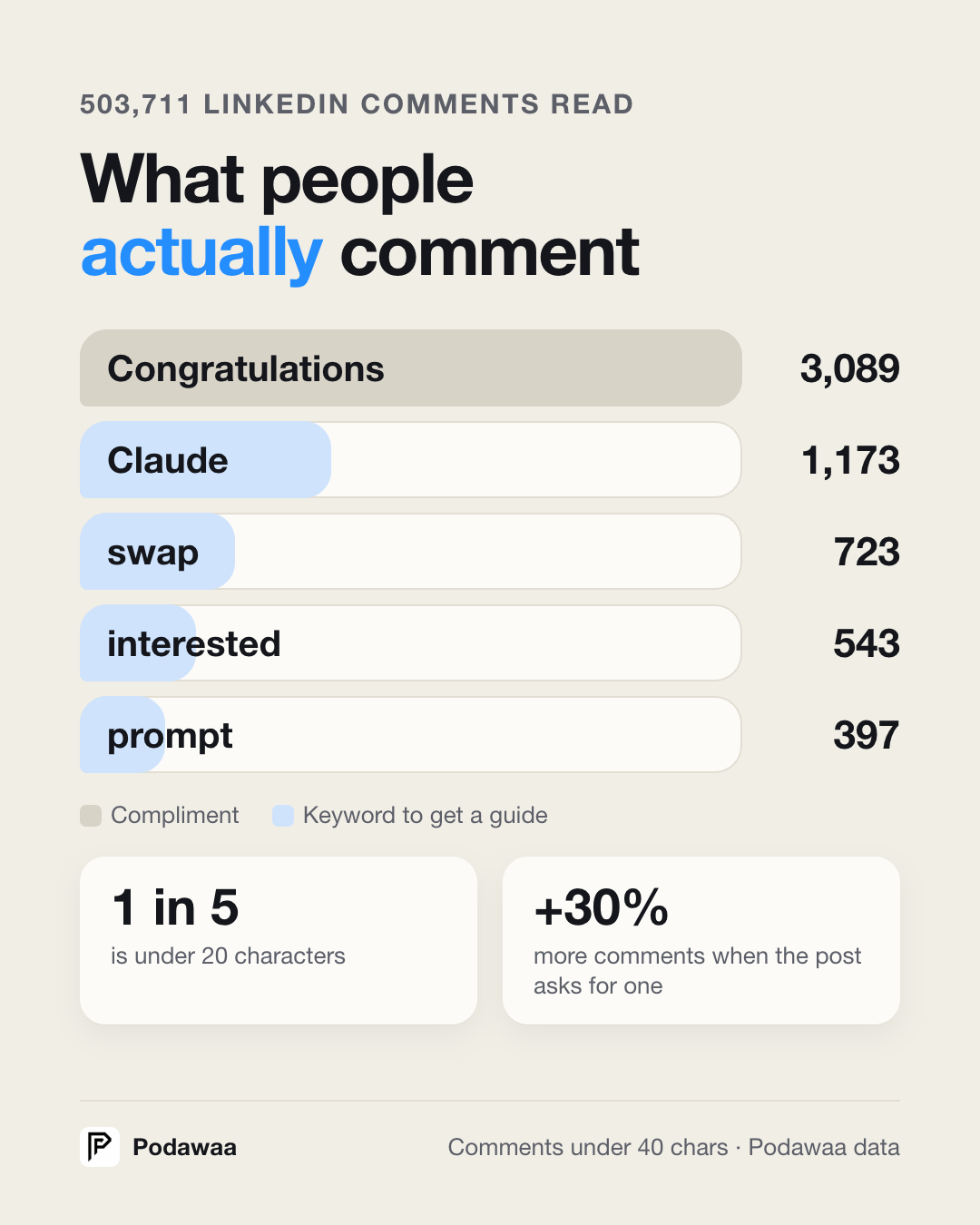
No. 1, by far: "Congratulations", over 3,000 times (3,089). Then the usual suspects: Love this, Thanks for sharing, Bravo, Well said. And CFBR, "commenting for better reach", a comment whose only purpose is to push the post.
The surprise: single keywords
Right behind "Congratulations" come comments that are not opinions at all:
| Comment | Count |
|---|---|
| Congratulations | 3,089 |
| Claude | 1,173 |
| swap | 723 |
| interested | 543 |
| prompt | 397 |
These are people answering a call to action: "Comment CLAUDE and I'll send you my guide." The keyword-comment format has become one of the most visible patterns on LinkedIn. It produces lots of comments, but they carry no conversation.
Comments are rare: 1 for every 9 reactions
Across posts from the last 12 months, there are 0.112 comments per reaction, roughly 1 comment for every 9 likes. Reacting takes one tap; commenting takes a thought. That scarcity is why comments carry so much weight in how far a post travels.
Asking for comments works: +30%
We compared each author's posts that explicitly ask for a comment (a question, "tell me in the comments", "what would you add?") with their other posts. Relative to the author's median, comments go from 1.10 to 1.43: 30% more comments for the same person.
The lesson is simple: if you want comments, ask for them. A genuine question at the end of a post is the easiest change you can make today.
How to write comments that stand out
If 1 comment in 5 is a two-word compliment, a thoughtful one gets noticed by the author and by everyone reading the thread. Add a fact, an example, or a respectful disagreement. Our guides on how to comment professionally on LinkedIn and on AI LinkedIn comments go further.
More from the same study
- Do hashtags hurt LinkedIn reach? Not once each author is compared to themselves.
- Em dash, AI words, post length: the em dash is not punished, and 1,300 to 2,000 characters get 65% more reactions.
How Podawaa helps
Asking for comments only works if people see the question. Podawaa puts a fresh post in front of relevant professionals in its first hour, so your post has a chance to start a real conversation. It does not guarantee reach or comments. The Free plan includes 5 boosts per month with no card; paid plans start at €29/month. Create a free account.
FAQ
What is the most common comment on LinkedIn?
"Congratulations", by far: 3,089 times among short comments in our sample of 503,711 comments.
Why do people comment single words like "Claude" or "prompt"?
They are answering a call to action such as "comment CLAUDE and I'll send you the guide". The comment is a request for a resource, not an opinion.
How many comments does a LinkedIn post get compared to likes?
In our data, about 1 comment for every 9 reactions (0.112 comments per reaction).
Does asking for comments really work?
Yes, in our data. For the same author, posts that explicitly ask for a comment get 30% more comments (1.43 vs 1.10 relative to the author's median).
Source: Podawaa database, 503,711 comments received on LinkedIn posts published between October 2025 and October 2026, authors' own replies excluded; extracted October 12, 2026. These are correlations observed in our data, not a description of LinkedIn's ranking system.