Loud working is the 2026 reflex of making sure your work gets seen. According to a MyPerfectResume survey of 1,000 US workers, 70% believe visible employees are rewarded more, and 56% have used at least one tactic to look busy. (We unpack the phenomenon in Loud Working: why being seen now matters as much as the work.)
Inside a company, loud working often turns into theater: late-night messages, full calendars, status updates nobody needs. On LinkedIn, it can be something much more useful: a public, durable record of what you actually achieved. Your manager sees your Slack. Recruiters, clients and your next employer see your LinkedIn.
This guide shows how to do loud working on LinkedIn the right way: visible, but real. You will find a 4-question test, five post formats, a worked example, a template you can copy, and what to do so that your post is actually seen.

Why LinkedIn is the right place to be "loud"
- It outlives your job. Internal messages disappear when you change teams. A LinkedIn post about a project you led stays attached to your name.
- It reaches beyond your manager. Peers in other companies, recruiters and potential clients form an opinion of you from what they see there.
- It rewards substance. A post with a concrete result, a number or a lesson earns comments. A post that says "busy week!" earns nothing.
- It is still under-used. Most professionals read LinkedIn but rarely post. Showing your work regularly already sets you apart.
Activity posts vs result posts
The trap of loud working is to make activity visible instead of results. On LinkedIn, it looks like this:
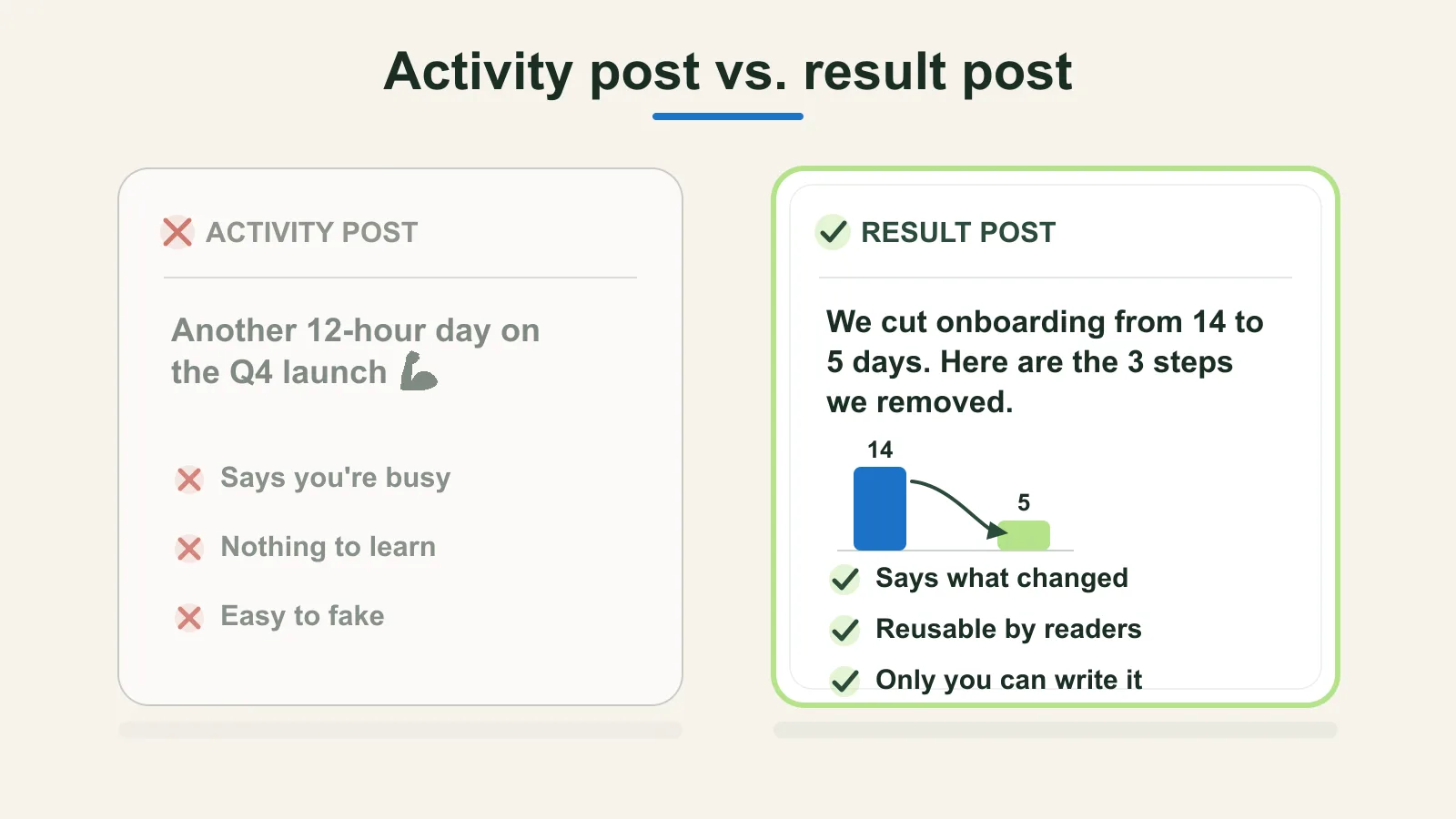
- Activity post: "Another 12-hour day, grinding on the Q4 launch 💪". It says you are busy. Nobody learns anything, and it is easy to fake.
- Result post: "We cut our onboarding from 14 days to 5. Here are the 3 things we removed and the one we wish we had kept." It says something changed, and people can reuse it.
With AI, activity posts are about to flood every feed. When anyone can generate a polished "humble-brag" in ten seconds, the posts that stand out are the ones with details only the person who did the work could know: the real number, the thing that failed, the name of the colleague who found the fix.
The 4-question test for a "loud" post that is real
Before publishing, answer these four questions. If you cannot, the post is probably activity, not a result.

1. What changed?
Start with the outcome: a number, a decision, a problem that no longer exists. "Our support backlog went from 300 tickets to 40" beats "I worked hard on support." If you cannot share the exact number, share the direction and the scale: "we halved", "from weeks to days".
2. What was hard?
The obstacle is what makes the story credible and interesting. What went wrong, what you tried first, what you had to drop.
3. What can the reader reuse?
A method, a checklist, a mistake to avoid. This is what turns a post about you into a post that is useful to others, and what makes people save and share it.
4. Who deserves credit?
Tagging the people who helped is honest, and it makes the post more credible. It also brings their networks into the conversation.
From activity to result: a worked example
Here is the same week told two ways (a fictional example).
Before (activity):
Crazy week. Back-to-back calls, late nights, but we're getting there with the new pricing page. Proud of the team! 🚀
After (result):
Our new pricing page went live on Tuesday. In the first week, demo requests from that page went from 9 to 23.
What made the difference was not the design. It was removing two of our four plans: people were comparing instead of choosing.
What I'd tell anyone redoing a pricing page: test fewer options before you test colors.
Huge thanks to Sarah, who ran the customer interviews that showed us the problem.
Same work, same week. The second version answers the four questions, gives the reader something to reuse, and credits a colleague. It is also impossible to generate without having done the work.
A template you can copy
[Result in one line: what changed, with a number if you can share it.]
[The obstacle: what was hard, or what we got wrong at first.]
[The lesson: one thing the reader can apply to their own work.]
[Credit: who helped, tagged.]
[Optional question to start the conversation.]
Need more formats? Our LinkedIn case study post examples and tips to write better LinkedIn posts are good starting points.
5 types of posts that show your work
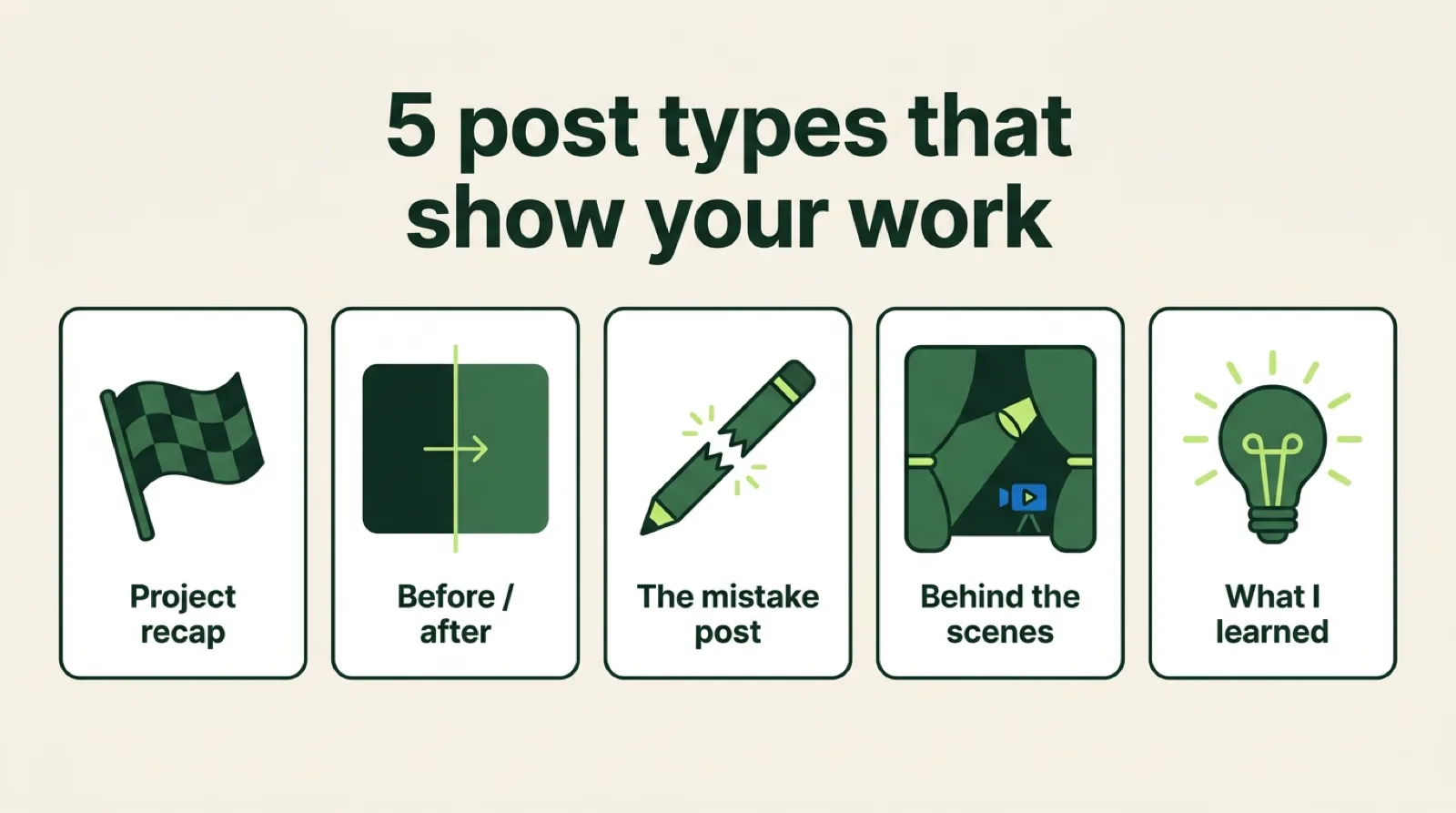
- The project recap: what you shipped, the result, and one lesson.
- The before/after: a process, a metric or a page before and after your work. A screenshot or a simple chart makes it instantly readable.
- The mistake post: what went wrong and what you changed. Often the most commented format, because everyone has been there.
- The behind-the-scenes: how a decision was really made, with the trade-offs.
- The "what I learned" post: three to five concrete lessons from a quarter, a launch or a year.
How often, and when?
- Rhythm: one strong result post every week or two beats a daily stream. You only need as many posts as you have real results.
- Timing: publish when your audience is online, typically on weekday mornings in their time zone, and stay around for the first hour to answer comments.
- Keep a log: write one result down every Friday. When you sit down to post, you are choosing from a list instead of staring at a blank page.
What to avoid
- Posting about long hours as proof of value.
- Sharing confidential numbers or client names without permission. Check your company's policy first, and use percentages or orders of magnitude when in doubt.
- Taking sole credit for team work.
- Publishing every day just to stay visible. Fewer, better posts that reach the right people beat a daily stream nobody reads.
- Letting AI write the whole post. Use it to structure or edit, but the details have to be yours, otherwise the post looks exactly like everyone else's.
The overlooked part: getting your post seen
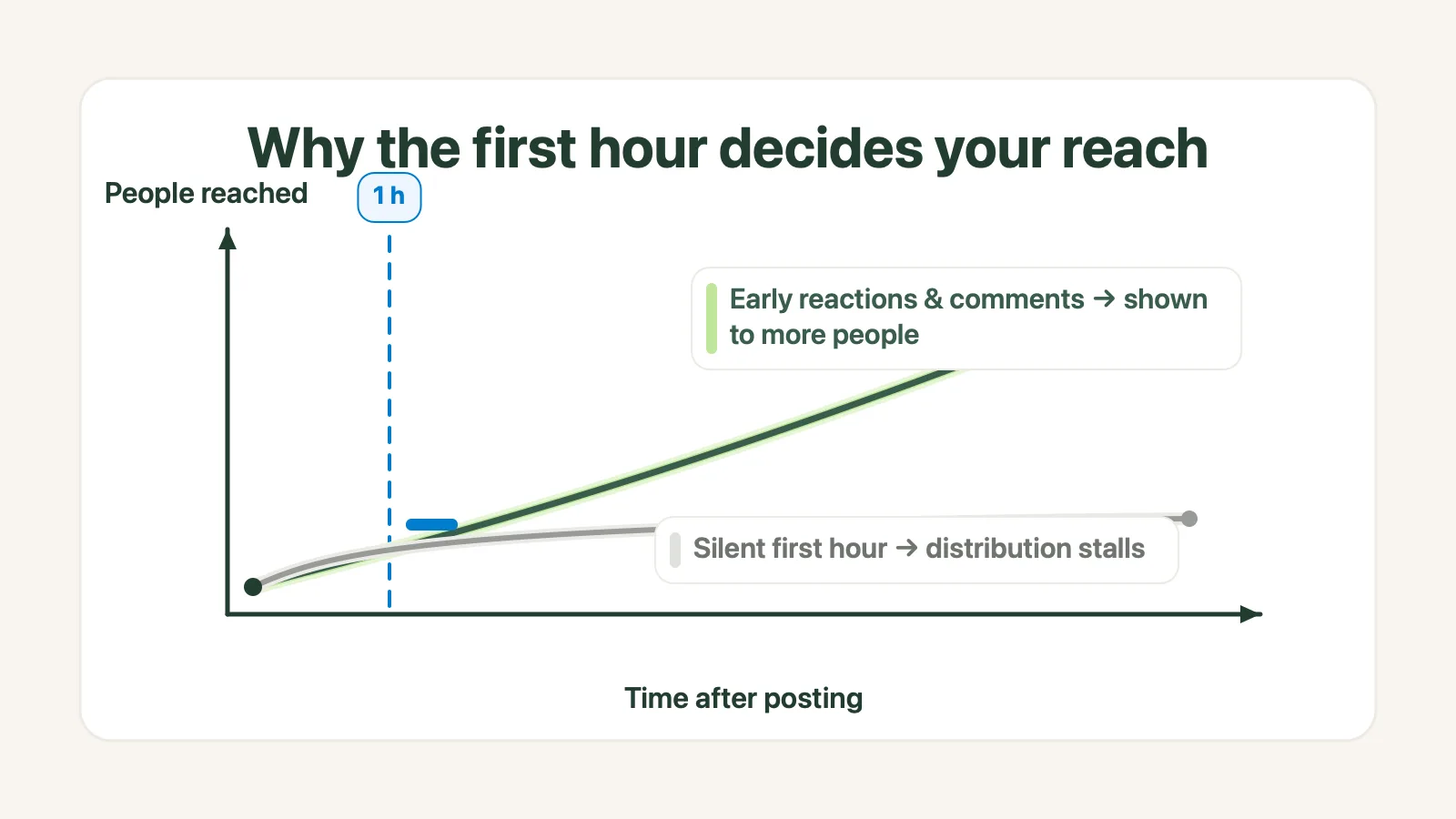
You can write the perfect result post and still see it reach 200 people. LinkedIn tests each post on a small audience first. If it gets early reactions and comments, it is shown to more people. If the first hour stays quiet, distribution stalls. That is why timing and early engagement matter so much (see your first 60 minutes on LinkedIn).
Many employees give up at this point. They wrote something real, nobody reacted, and they conclude that LinkedIn is only for influencers. The work was good. The first hour was empty.
How Podawaa helps employees show their work on LinkedIn
Podawaa is built for exactly that gap between a good post and a seen post.
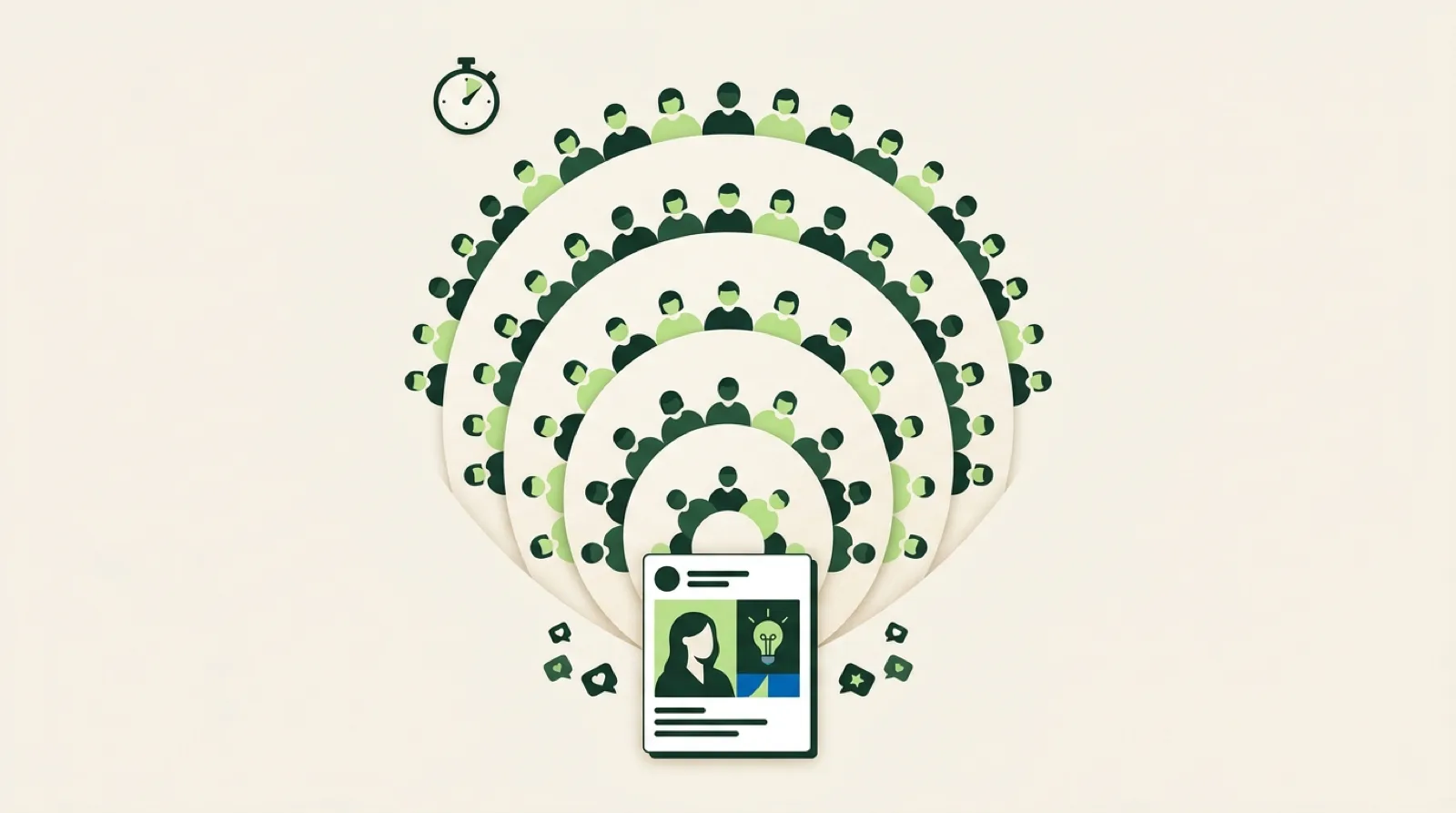
- A first wave of real engagement. When you publish a project recap or a lesson learned, a Boost connects your post to real LinkedIn users, so it starts with reactions and comments instead of silence.
- People who are relevant to you. Podawaa matches your post with users in your language (English, French or Spanish) and your industry, through its matching engine Jev. Learn more in how Podawaa matches the right people to your post.
- Fully automatic. You do not have to spend an hour a day engaging with others to earn your own visibility. That is time you can put back into the work you want to show.
- Boost only what matters. You choose which posts to boost: the results worth being loud about, not every post.
- Start for free. The Free plan includes 5 boosts a month, no card required. Paid plans start at €29/month for more boosts and automation.
Podawaa does not guarantee reach, and it will not save a post with nothing to say. What it does is give your real results a fair chance to be seen by the people who should see them. Curious about the mechanics? Read our guide to getting more LinkedIn likes, free and real.
FAQ
What does loud working on LinkedIn mean?
It means making your work visible on LinkedIn: sharing projects, results and lessons publicly so that your network, recruiters and clients see what you achieve, not just your job title.
Is it OK to post about my work on LinkedIn?
Yes, as long as you respect confidentiality. Share outcomes, methods and lessons, and avoid internal numbers or client names unless your company allows it.
What should a result post include?
Four things: what changed (ideally with a number or an order of magnitude), what was hard, one lesson the reader can reuse, and credit for the people who helped. A short question at the end can start the conversation.
Can I post about my work if it is confidential?
Usually yes, by sharing the method and the lesson instead of the sensitive details. Replace exact figures with percentages or orders of magnitude, leave out client names, and check your company's social media policy before posting.
How often should I post about my work?
Quality beats frequency. One strong result post every week or two, with good early engagement, does more for your reputation than a daily stream of activity updates.
Should I use AI to write my LinkedIn posts?
Use it to structure, shorten or proofread, not to invent the content. The details that make a result post credible, the real number, the thing that failed, the colleague who found the fix, can only come from you.
Why do my posts about my work get so few views?
LinkedIn first shows each post to a small audience. Without early reactions and comments, it stops distributing it. Posting at the right time, asking a real question and getting a first wave of engagement all help.
How does Podawaa help my posts get seen?
A Podawaa Boost connects your post to real LinkedIn users matched by language and industry, so it gets early engagement automatically. It does not guarantee reach, and the Free plan includes 5 boosts a month, no card required.
Source for the statistics: MyPerfectResume survey of 1,000 US workers, via PR Newswire (October 6, 2026).