LinkedIn case study posts are the most credible format on LinkedIn, because they show something actually happened: a test ran, a result changed, a number moved. That specificity is what makes people save and share rather than just scroll.
Any test you ran, any tool you tried, any strategy you tracked for more than two weeks is a case study waiting to be written. Let’s take a look at 10 best examples:
How We Built This List
We reviewed real, high-performing LinkedIn case study posts from creators across marketing, tech, and SEO, looking for ones that documented an actual test, experiment, or result with real data.
For other formats, we pulled the closest match from Podawaa's library of 150+ post templates and filled it in with a realistic example, so you can see exactly how the format reads before adapting it with your own numbers.
What Makes a Good LinkedIn Case Study Post
A good case study post shows something that actually happened. Here is the structure every strong example on this list follows:
- Opens with a specific result, number, or claim and not a general observation. The hook is where most case study posts fail.
- Names the exact thing that was tested, tried, or tracked
- Shows what changed, not just what was learned
- Includes at least one concrete data point, even a small one
- Ends with a takeaway or a question that invites a reply. The first comment extends that conversation
The most common mistake is writing a case study post that reads like advice. If your post could have been written by someone who did not do the thing, it is not a case study. It is an opinion post.
One thing worth knowing before you write your next LinkedIn post: Podawaa's Viral Score rates your hook and post structure out of 100 before you publish. It is free and takes one click.
Now let’s go straight to examples and why they work.
1. The Data Case Study
Data case study posts take a third-party stat or research finding and add a sharp personal interpretation that makes the reader see it differently. The key is not just sharing the data but telling the reader what it means specifically for them.
Brian Dean has over 98,000 followers on LinkedIn and posts regularly about AI search and SEO. In a recent post, he opened with a single number: half of B2B software buyers now start their research with AI, not Google.
Then he immediately named the source (G2's survey of 1,000+ B2B buyers), added the historical comparison (29% eleven months earlier), and moved to the implication that changes behavior for SaaS founders.
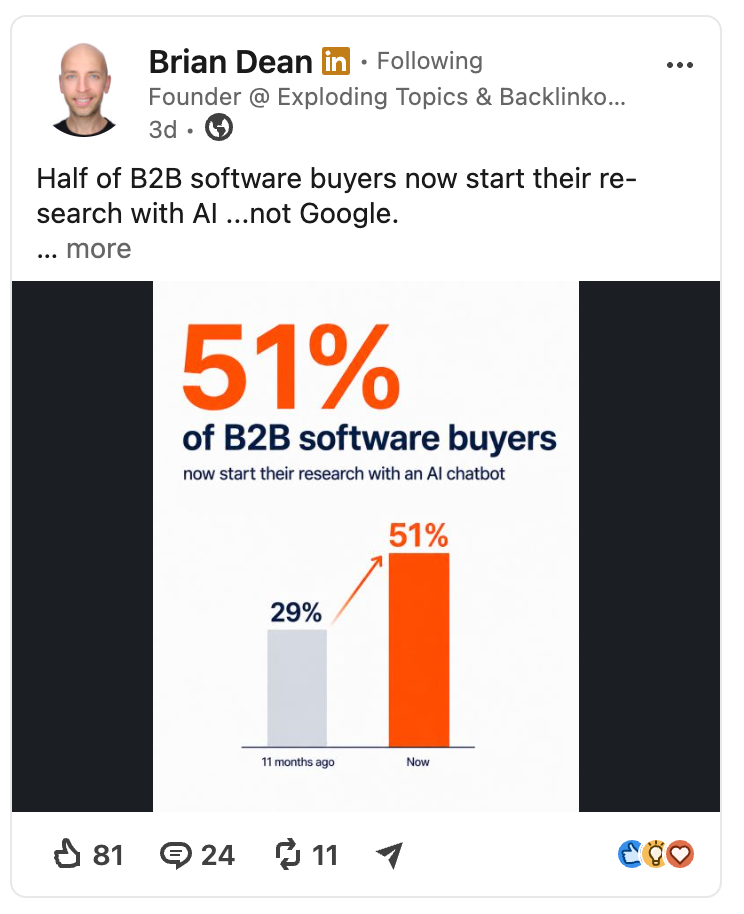
What makes this format work is the gap between the data and the interpretation. Anyone can share a statistic. The case study is in what you do with it. Brian does not just say AI search is growing.
He says 69% of buyers choose a different vendor than they originally planned based on what an AI chatbot tells them, then explains exactly what that means for small SaaS companies. That is a post people send to their teams.
2. The Research Case Study
You do not need a team or a large dataset for this format. One specific question, investigated carefully, with precise findings, is enough.
Tom Benattar, a SaaS founder talking about SEO, GEO, ran his own analysis on a single AI search query: "Best tool for multichannel sequences?" He tracked which sources AI systems cited, how many times, and what patterns emerged. The result was six specific findings about GEO that most people in the space were not teaching clearly.
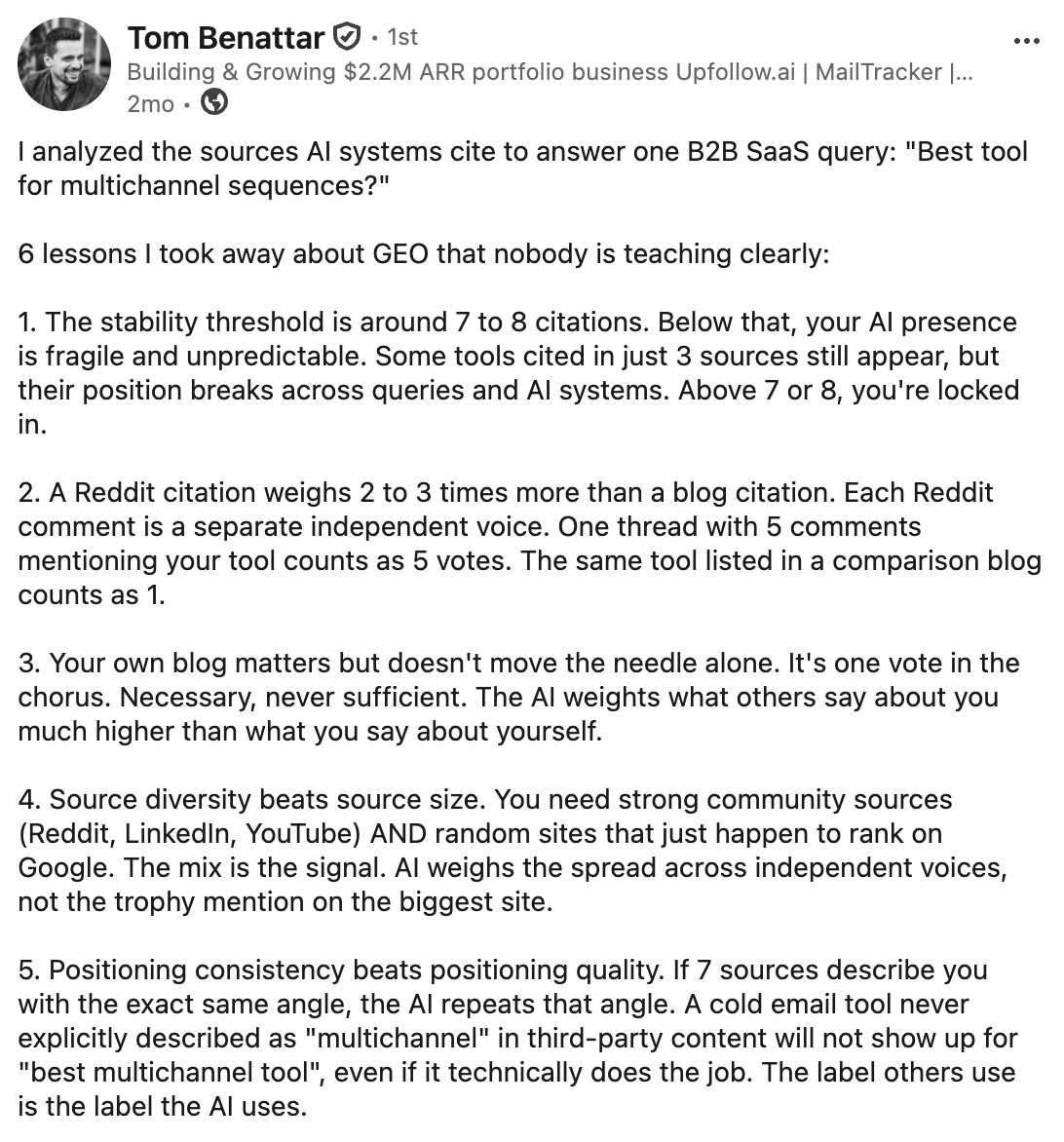
What makes this format work is the precision of the numbers. Not "Reddit matters for AI visibility" but "a Reddit citation weighs 2 to 3 times more than a blog citation." Not "you need consistency" but "the stability threshold is around 7 to 8 citations."
Anyone can share a general observation. The case study is in the specific number attached to a specific thing you actually studied. That specificity is what makes people save the post and send it to their team.
3. The Before, During, After Case Study
The before/during/after format forces you to show all three stages, which is what makes it feel credible rather than curated. For more on how this structure works as a story format, see our LinkedIn storytelling examples.
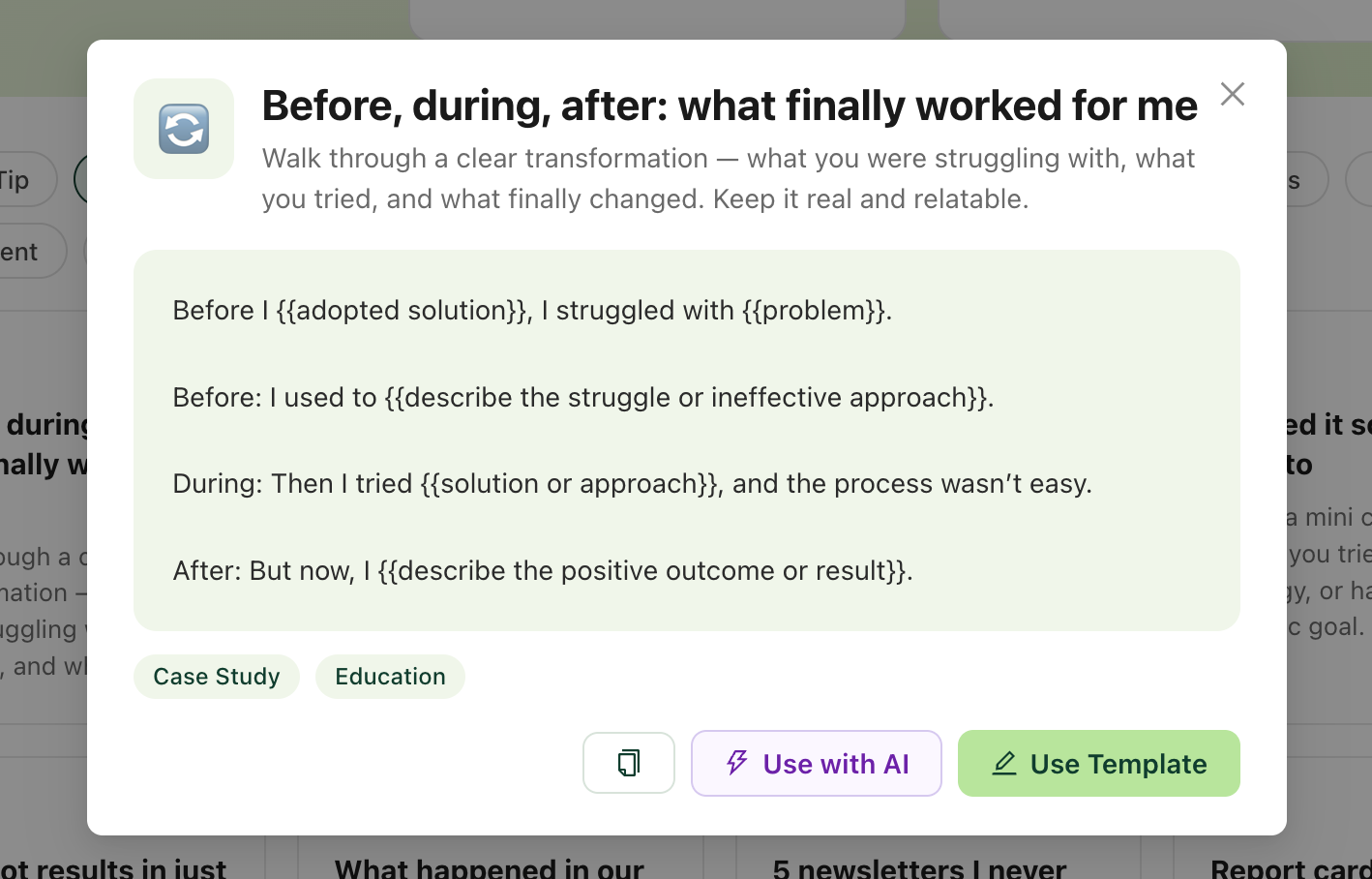
Here is what this looks like as a finished LinkedIn post:
I spent six months posting on LinkedIn with almost no results.
Average 11 likes per post. One comment on a good week. I was doing everything the advice said: educational content, consistent schedule, strong hooks.
The shift happened when I stopped writing posts and started documenting experiments.
During: I picked one thing to test each month. First month, I switched from educational carousels to short story posts. Engagement went up 40%. Second month, I added a first comment with a question to every post. Replies doubled. Third month, I stopped posting on Fridays. Nothing changed.
Now I post twice a week, every post follows a tested structure, and my average engagement is 4x what it was.
The content did not change much. The approach to creating it did.
What is one thing you have tested on LinkedIn?
Use this template when you have tracked a change over at least a month and have at least one number to anchor the before-and-after state.
4. The A/B Test Case Study
A/B test posts document a controlled experiment where one variable was changed and the result was measured. They work best when the finding is counter-intuitive, because that is what makes people stop and read.
For example, Brad Geddes, posted results from testing AI Max text customization across three campaign types. The post earned 64 likes and 16 comments, strong for a technical PPC audience. The hook was straightforward: "3 AI Max Text Customization Test Results."
The body gave the setup (ecommerce, B2B lead gen, B2C lead gen) and then a data table showing CTR, conversion rate, and CPA changes for each. The full article link went in the first comment.
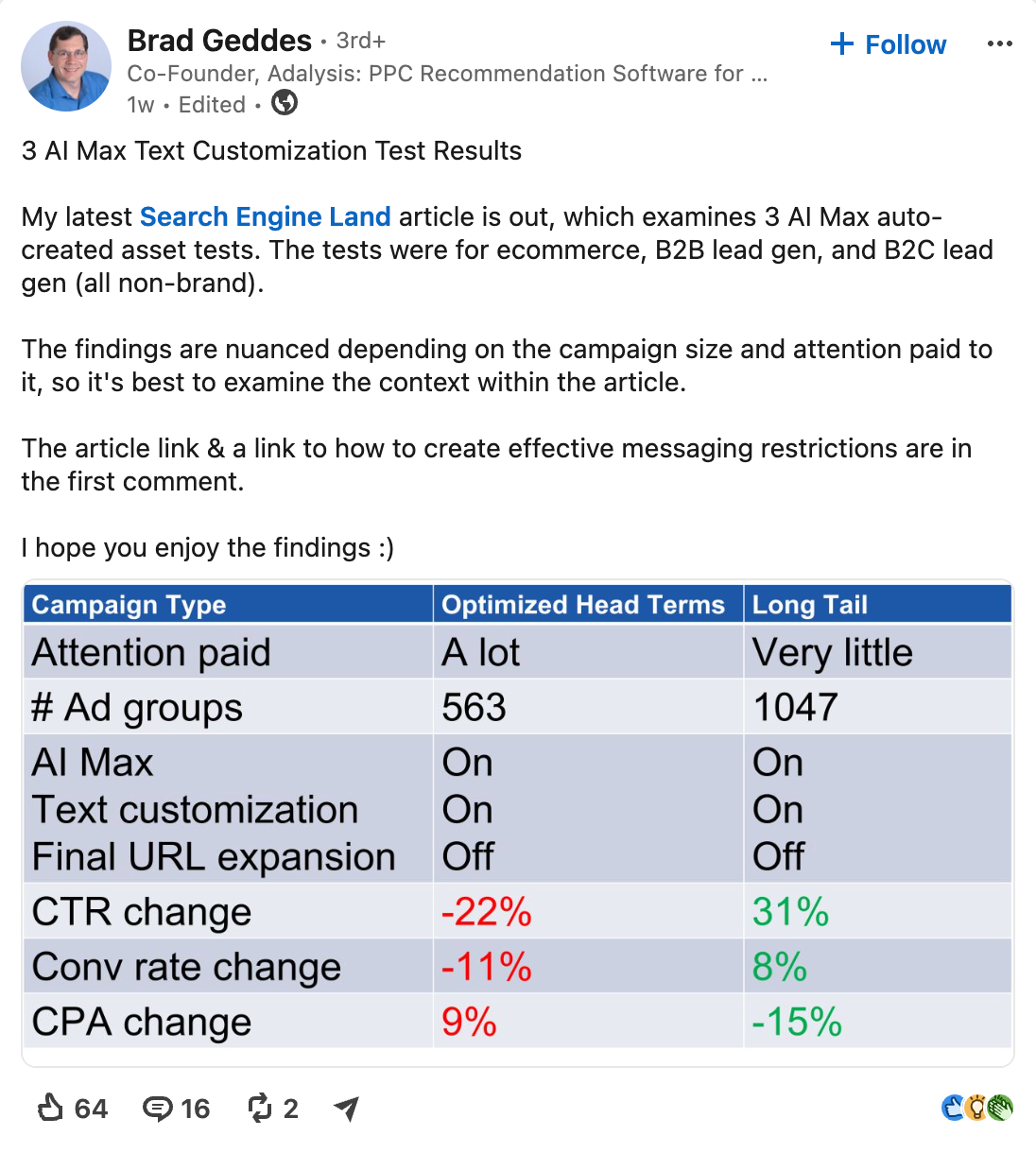
The table is doing most of the work. It takes a finding that could have been buried in a paragraph and makes it scannable in five seconds. If you have test results with more than one data point, put them in a table. It signals rigorous testing and makes the post significantly easier to share with a team.
5. The Honest Tool Review
This format gives a transparent evaluation of a tool or platform after actually using it. The structure is: what you expected, what you found, who it is actually for. The credibility comes from naming the negatives as clearly as the positives.
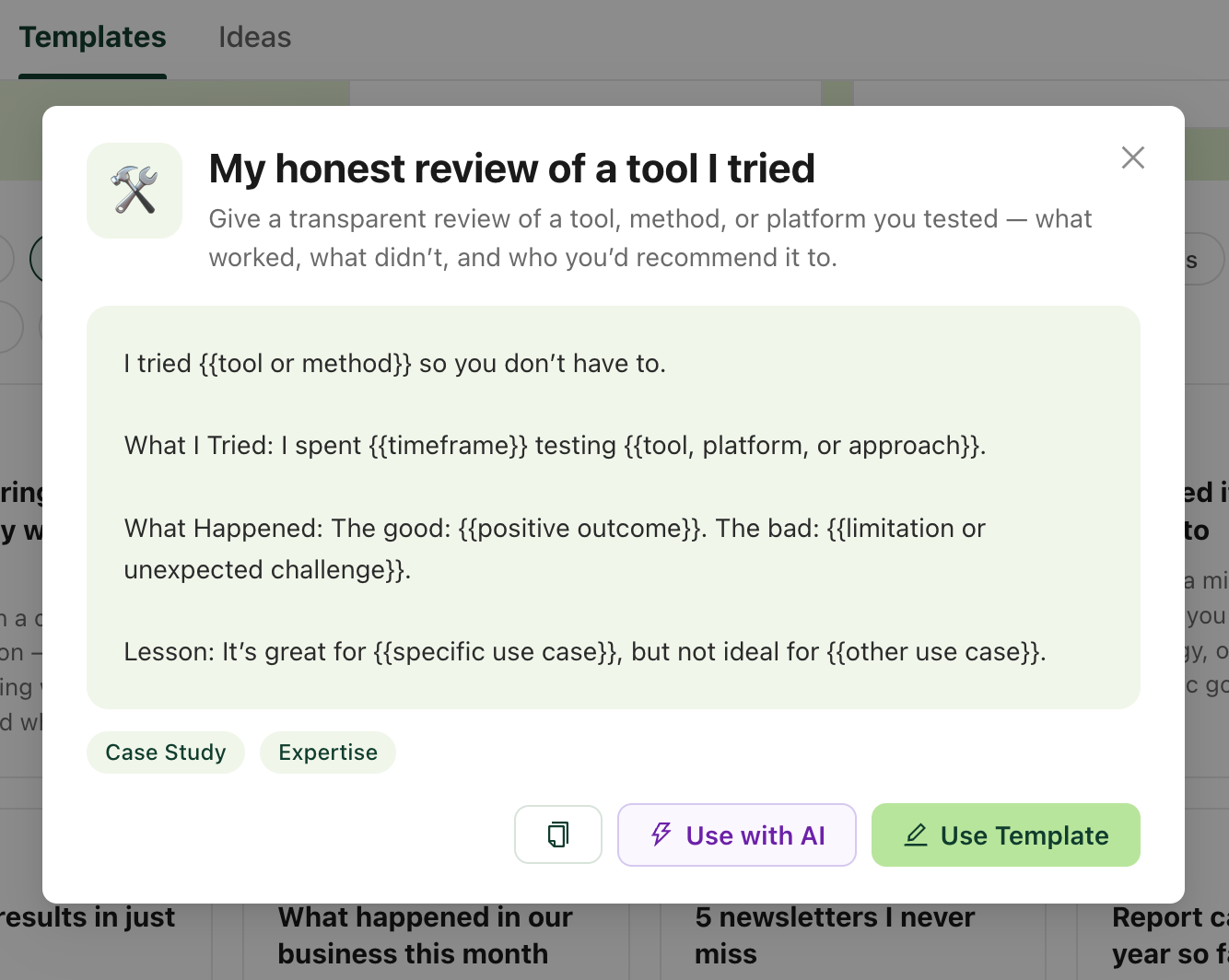
Here is what this looks like as a finished LinkedIn post:
I used Podawaa to plan my LinkedIn content for 30 days. Here is my honest take.
What I expected: a scheduling tool with some AI features.
What I found: the Viral Score changed how I write hooks. Before, I would write a hook, think it was fine, and post. Now I write three versions, check the score, and pick the one that creates the most tension in the fewest words. My average hook score went from 58 to 81 over 30 days.
What did not work for me: I still rewrite every AI-generated draft. The first version is always too generic. But that is how I use all AI writing tools, so not a surprise.
Who I would recommend it to: anyone who posts on LinkedIn more than once a week and wants a second opinion on their hook before publishing.
What tool has changed how you create content this year?
The key to this format is the specificity of what changed. "My average hook score went from 58 to 81" is a case study. "It helped me write better hooks" is an opinion.
6. The Visual Process Case Study
Visual process posts use a diagram or screenshot to explain something complex that would take three paragraphs to describe in text. They work because LinkedIn is a visual feed and a well-made diagram stops the scroll faster than any hook.
Chris Long, an AEO and SEO consultant, posted an explanation of how RAG (retrieval-augmented generation) works for SEOs who need to understand it.
The hook named the audience directly: "SEOs, if you want to learn how RAG works, read this." The diagram showed query decomposition and parallel retrieval in a format that made a technical concept immediately understandable.
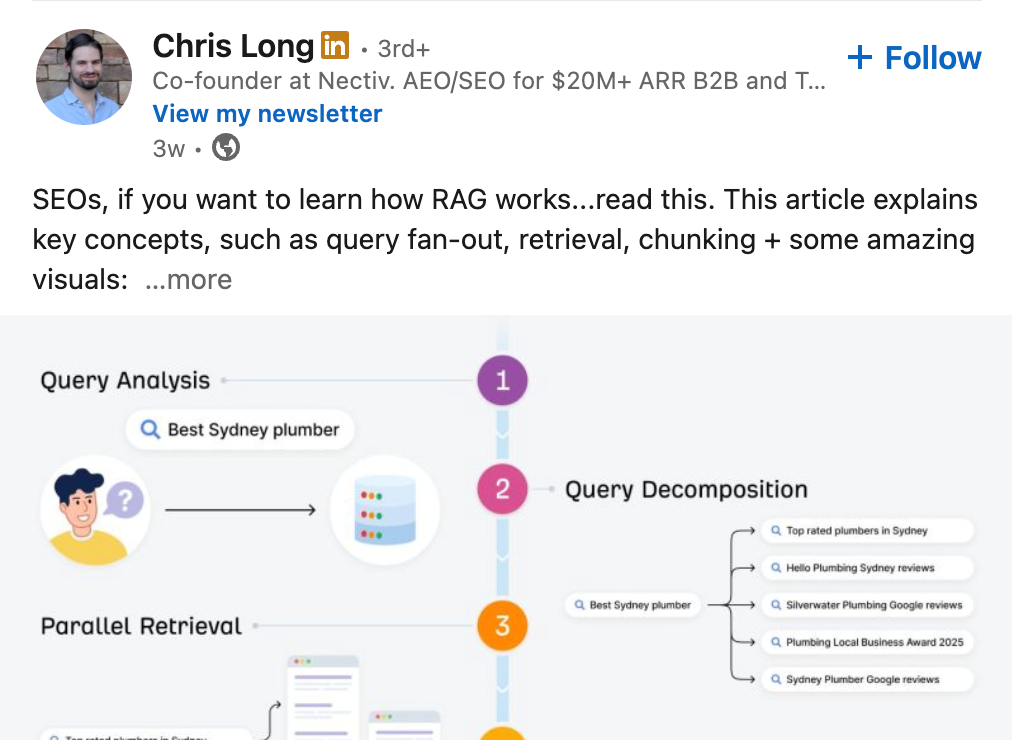
What makes this format a case study rather than just an educational post is that the creator is documenting how something actually works based on direct experience with it.
Chris is an AEO consultant who works with this technology daily. The diagram is evidence of understanding, not just an illustration of a concept he read about.
7. The "When Best Practices Didn't Work" Case Study
This format challenges a widely held belief in your niche using your own experience as the evidence. The power is in naming the specific advice that failed, not just saying "conventional wisdom was wrong."
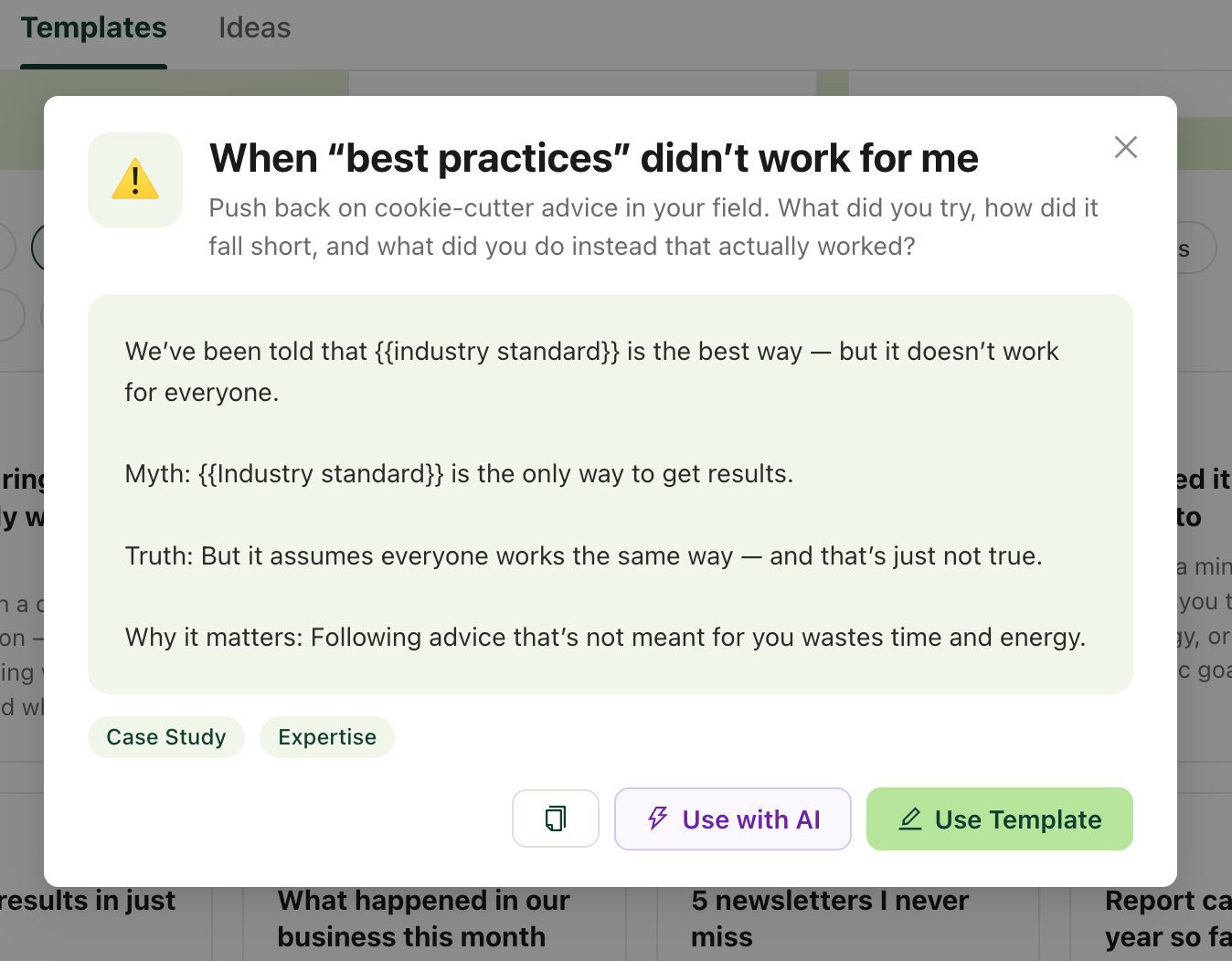
Here is what this looks like as a finished LinkedIn post:
I followed the "post every day" advice for 60 days straight.
The theory: consistency signals quality to the algorithm. More posts, more reach, more followers.
What actually happened: my engagement dropped by a third by week three. I was running out of ideas, the posts felt rushed, and I stopped caring whether they were good.
What I did instead: I switched to twice a week and spent the extra time on the hook and the first comment. Engagement recovered within two weeks and kept climbing.
The "post every day" advice works if you have a system for generating ideas and a high tolerance for producing content that is just okay. I did not have either.
What LinkedIn advice have you tried that completely backfired?
This format generates comments because it invites disagreement. Some readers will have had the same experience. Others will push back. Both are good outcomes.
8. The Time-Bound Case Study
Time-bound case study posts document what happened over a short, specific window. Three days, one week, thirty days. The constraint is what makes it credible, because it implies the creator actually tracked something rather than estimating from memory.
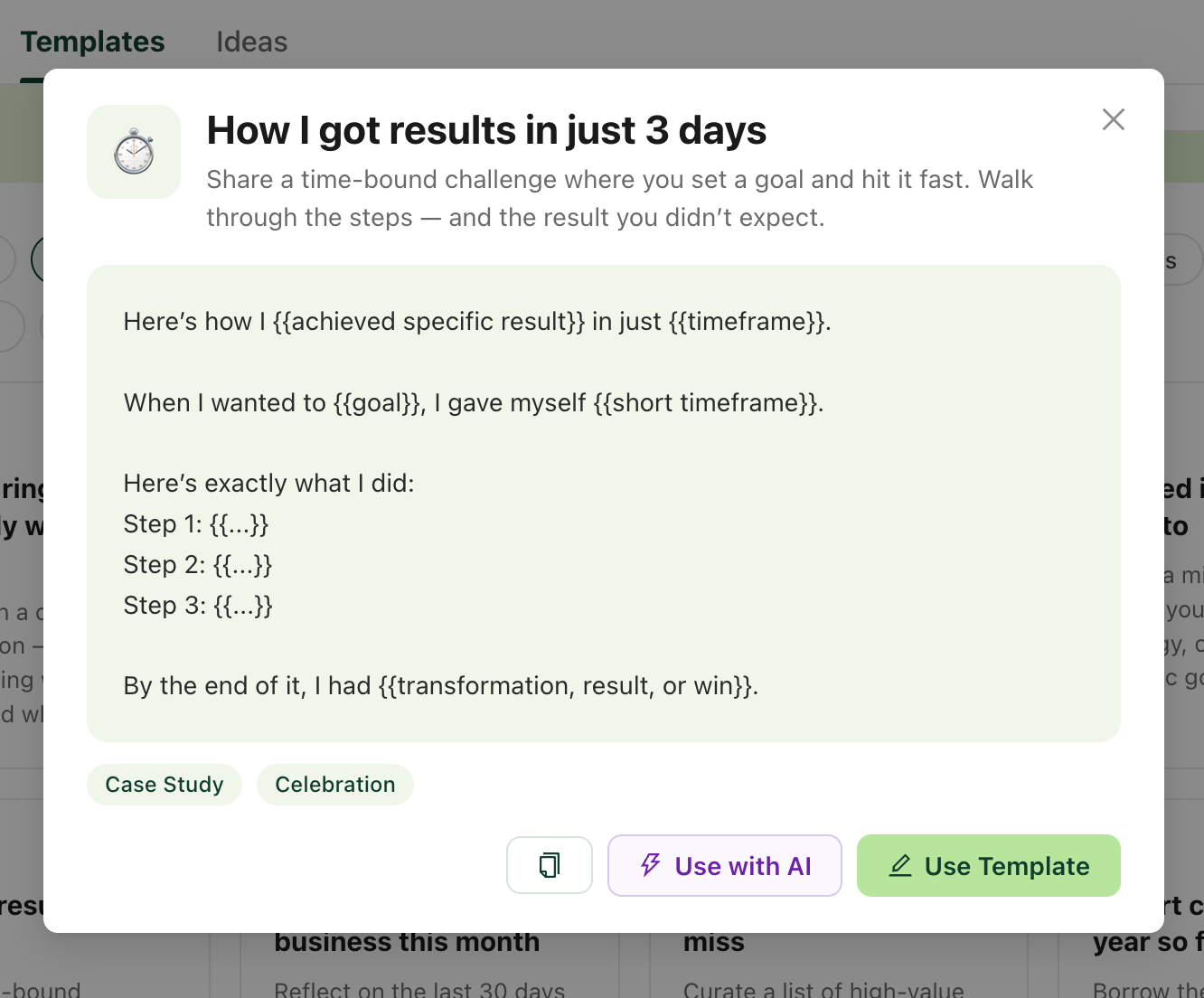
Here is what this looks like as a finished LinkedIn post:
I rewrote my LinkedIn headline on a Monday. By Thursday, three inbound messages had arrived from people I had never spoken to.
The old headline: "Marketing Consultant | Helping brands grow."
The new headline: "I help B2B SaaS companies get their first 1,000 LinkedIn followers without paid ads."
Same person. Same experience. One is a job description. The other is a promise to a specific person.
I did not change anything else that week. No new posts, no new connections, no outreach.
Your headline is the first thing someone reads when they visit your profile. If it does not tell them exactly what you do and who you do it for, they leave.
You can also add a first comment with Podawaa, for example, like this one: When did you last update yours?
9. The Monthly Business Recap
Monthly recap posts document what happened in your business or content in the last 30 days. They work because they are honest by definition.
A monthly update that only shows wins reads like marketing. One that includes a mistake or a surprise feels real.
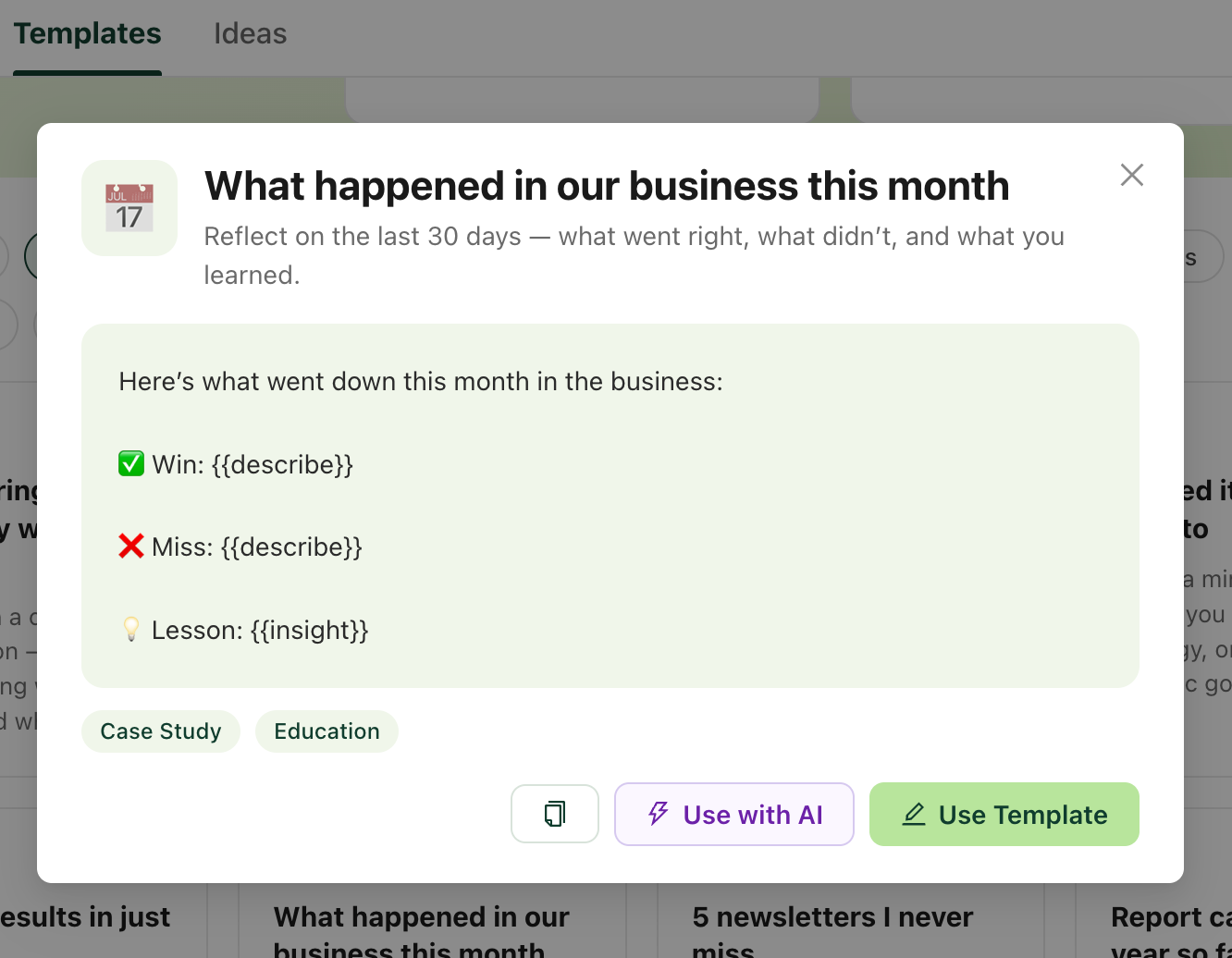
Here is what this looks like as a finished LinkedIn post:
Month 4 of building in public. Here is what actually happened.
What went well: crossed 500 newsletter subscribers. Two clients came directly from LinkedIn, both said they had been reading my posts for weeks before reaching out.
What did not go well: I missed a week of posting because I tried to batch a month of content in one day and burned out by Wednesday. Did not work, back to weekly batching.
What surprised me: the post I thought was mediocre got the most saves of anything I published this month. The one I spent three hours on got 14 likes.
The lesson I keep relearning: the reader decides what is valuable, not me.
If you build in public, what is one thing from this month you did not expect?
10. The Year-End Lessons Case Study
Year-end posts document what changed over twelve months. They work best when the lessons are specific and honest, not a list of generic reflections the reader could have written themselves.
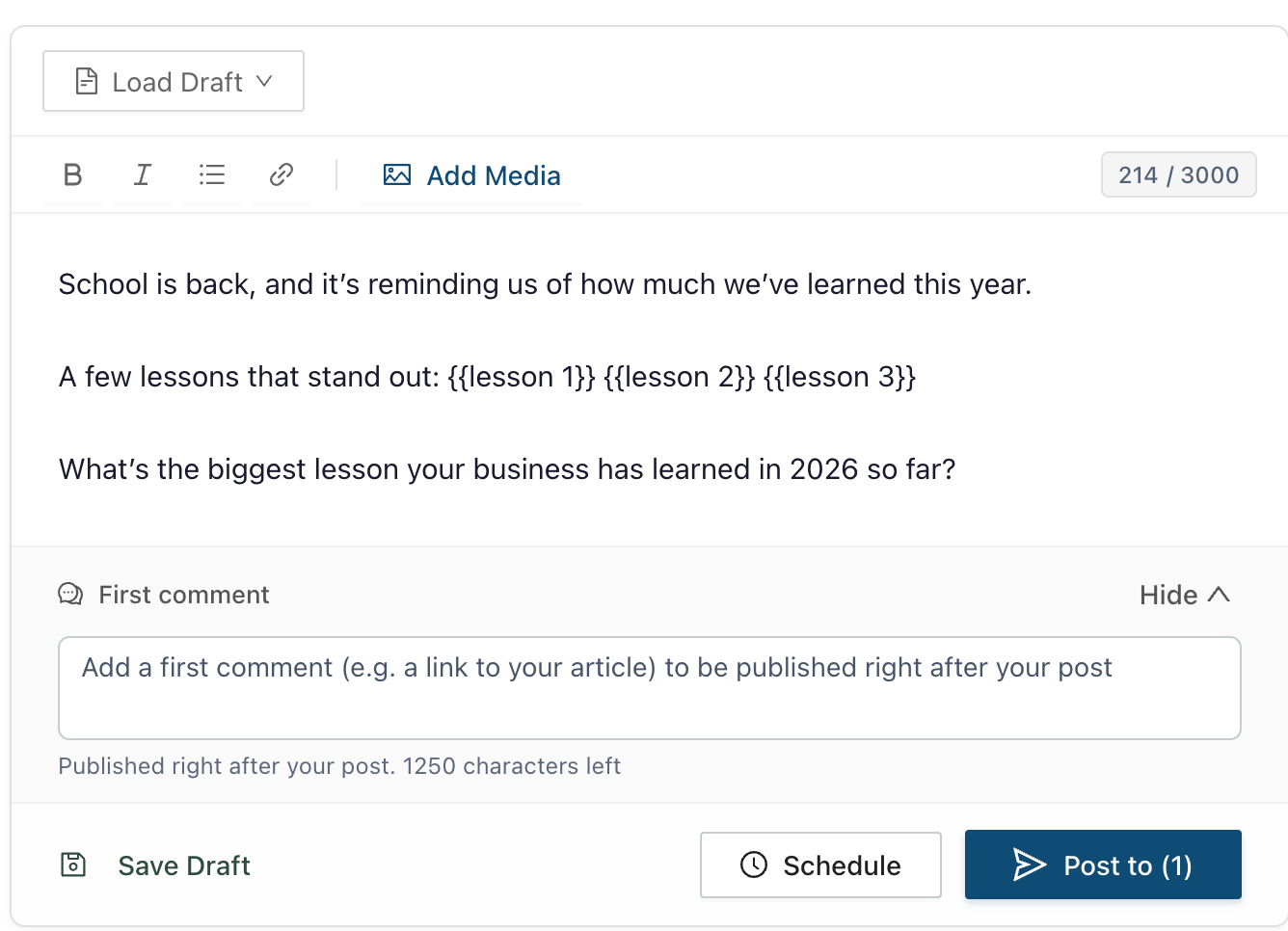
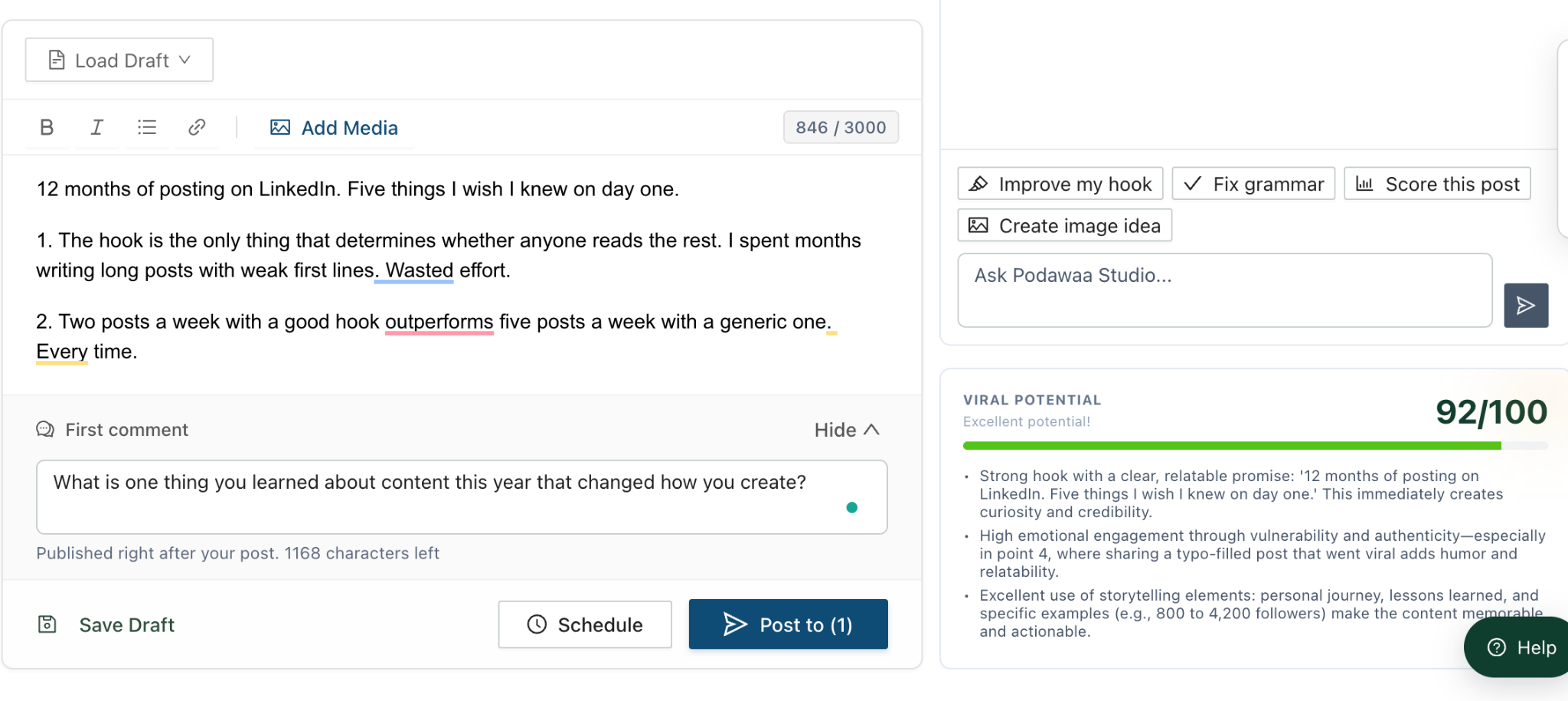
Here is what this looks like as a finished LinkedIn post:
12 months of posting on LinkedIn. Five things I wish I knew on day one.
1. The hook is the only thing that determines whether anyone reads the rest. I spent months writing long posts with weak first lines. Wasted effort.
2. Two posts a week with a good hook outperforms five posts a week with a generic one. Every time.
3. The first comment is not optional. It appears separately in other people's feeds and gives the same post a second chance to reach people who scrolled past it.
4. Your most embarrassing post will outperform your most polished one at least once. Mine was a typo-filled observation I almost deleted. 300 likes.
5. LinkedIn rewards specificity. "I helped a client grow their audience" gets ignored. "I helped a B2B consultant go from 800 to 4,200 followers in 90 days by switching from educational posts to case studies" gets saved.
We ran this post through Podawaa's Viral Score before publishing. It scored 92/100.
Once you publish a case study post, the first hour matters most. LinkedIn decides how widely to distribute a post based on early engagement signals.
Podawaa's Boost feature lets you paste your LinkedIn post URL and get real engagement from relevant people in your niche within minutes, which is particularly useful for case study posts since early traction signals to the algorithm that the content is worth distributing further.
All 10 Case Study Formats at a Glance
All case study templates are available inside Podawaa under the Case Study filter. Select one, open it in the editor, and replace the placeholders with your own experience.
Frequently Asked Questions
What is a case study post on LinkedIn?
A case study post documents a real test, experiment, result, or transformation with specific data. The minimum requirement is one concrete data point tied to one specific action. If you want to see what this looks like across different story structures, our LinkedIn storytelling examples covers the formats closest to the case study style.
Do I need a big result to write a case study post?
No. Specificity matters more than scale. "I changed my LinkedIn headline and got three inbound messages in 72 hours" is a better case study than "I grew my audience by 10,000 followers last year" if the first one explains what changed and why.
How long should a LinkedIn case study post be?
Between 150 and 300 words. If you need more space, put the full breakdown in the first comment and keep the post itself to the most surprising finding. If reach is something you are working on, see our guide on why your LinkedIn posts get no reach.
How do I know if my case study hook is strong enough?
Run it through Podawaa's Viral Score before publishing. A score below 65 means the hook is describing the post rather than creating tension. A score above 80 means the first line creates a gap the reader wants to close.
How often should I post case studies on LinkedIn?
Once a month is a strong baseline. One honest, specific case study outperforms four vague ones. Mix them with story posts and educational content for a balanced month. Our LinkedIn content strategy guide covers how to plan that mix.
How do I manage replies when my case study post gets comments?
Podawaa's Inbox collects all comments across your posts and shows which ones still need a reply. For case study posts specifically, the comments often include follow-up questions about your methodology or results, and responding quickly keeps the post active longer.
Can I write a case study post about someone else's result?
Yes. "We helped a client go from X to Y by doing Z" is a case study. Just be transparent about your role.