
I've seen a lot of creators ask this question right before they sign up for a pod. And I've seen what happens six months later when their reach has flatlined and they can't figure out why.
In this guide, I'm going to show you exactly what LinkedIn pods do to your account over time, what makes them risky, and how to use them without quietly killing your distribution.
In short: Pods can work early. The risk builds over time, and it almost never comes from detection. It comes from what repetitive engagement signals teach the algorithm about your content.
Do LinkedIn Engagement Pods Actually Work?
Yes, and that's exactly what makes them complicated.
You join a pod. Your next post gets 40 likes in the first two hours. LinkedIn's algorithm reads early engagement as a signal of content worth distributing. Your impressions go up. It feels like something clicked.
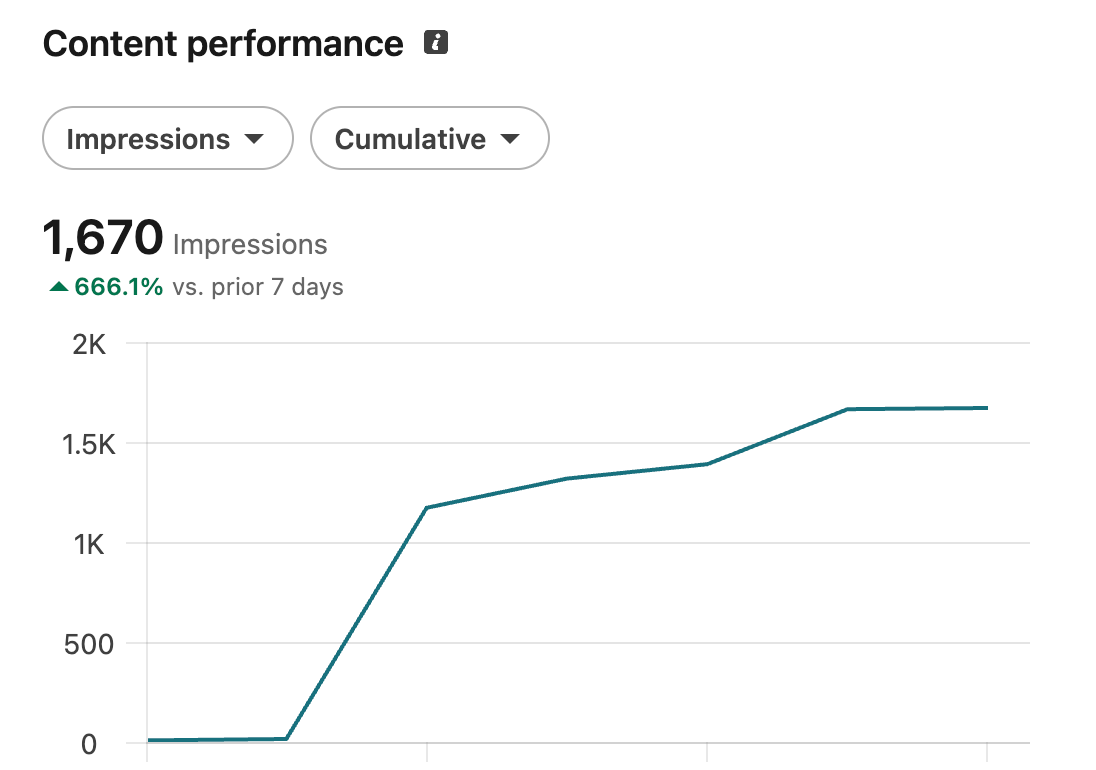
The problem isn't that first post. The problem is what happens after you've done this 20 times with the same group.
LinkedIn doesn't just count engagement. It evaluates who is engaging, how fast, and how often those same people have engaged before.
When those three signals start looking repetitive, the algorithm stops treating your engagement as evidence of genuine interest. It starts treating it as noise.
Tools like Podawaa were built around this exact problem. It works without connecting to your LinkedIn account at all (no login, no extension, no account access) so the configuration is entirely on your side.
Instead of giving you a raw number of likes with no context, it shows you what each choice actually signals to LinkedIn before you confirm it. More on that below.
Why LinkedIn Pods Become Less Effective Over Time
You've been posting consistently. Likes are coming in. But it's the same 30 people liking every post you've published for the past three months.
LinkedIn's feed algorithm works by testing content on a small initial audience, then deciding whether to expand.
That expansion decision is based on engagement quality: are the people reacting relevant to the topic? Are they diverse? Are they different from the last post's engagers?
When engagement comes from the same accounts repeatedly, those signals degrade. The algorithm has already learned everything it's going to learn from that group. It stops expanding. And because it's mapped your content to a narrow cluster, even your organic reach starts to shrink over time.
The LinkedIn impressions case study shows exactly how this curve behaves when engagement patterns stop diversifying.
The drop in impressions happens gradually, which is why most creators don't connect it to pod usage until months later.
What Happens to Your LinkedIn Reach When You Use Pods
Early impressions go up. Then they flatline. Then even the pod-driven spikes start feeling smaller, because the algorithm has already mapped your content to a narrow audience and stopped testing it on new people.
You're still getting likes. But you're not getting reach.
This is the pod trap: high engagement numbers, low distribution, no audience growth. Your posts have reactions. Your comments section has activity.
But your follower count isn't moving, and when you look at your LinkedIn metrics, impressions tell a completely different story than likes.
The LinkedIn follower growth case study shows what this looks like compared to accounts building genuine distribution. The gap between engagement numbers and actual growth is the clearest signal that something in the pattern is wrong.
How to Use Pods Without Hurting Your Account
If you're going to use pods, configuration matters far more than which tool you use.
Most basic pod tools give you one option: more engagement. No risk feedback. No visibility into whether you've crossed a threshold that's working against your distribution. You find out later, in your analytics, when the damage is already done.
Podawaa's configuration flow is built around showing you what each setting signals to LinkedIn before you commit. Here's what that looks like in practice.
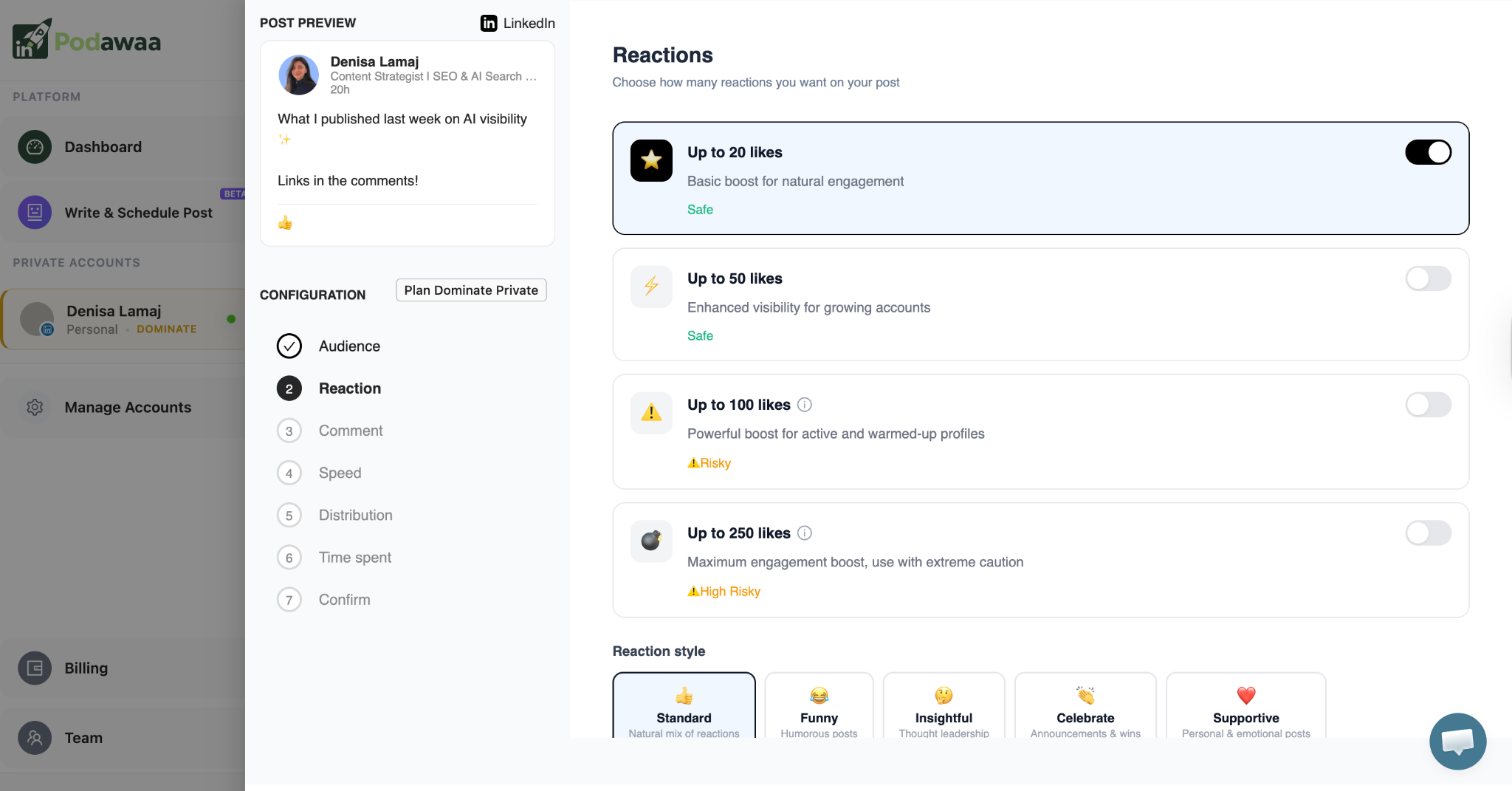
Audience targeting. Instead of sending your post to any available user, you can filter by language and use AI-selected targeting or industry-specific targeting.
This changes what LinkedIn learns about your audience from each post. Engagement from someone in your industry looks different to LinkedIn's system than engagement from a recruiter in an unrelated field, even if both clicked the same button.
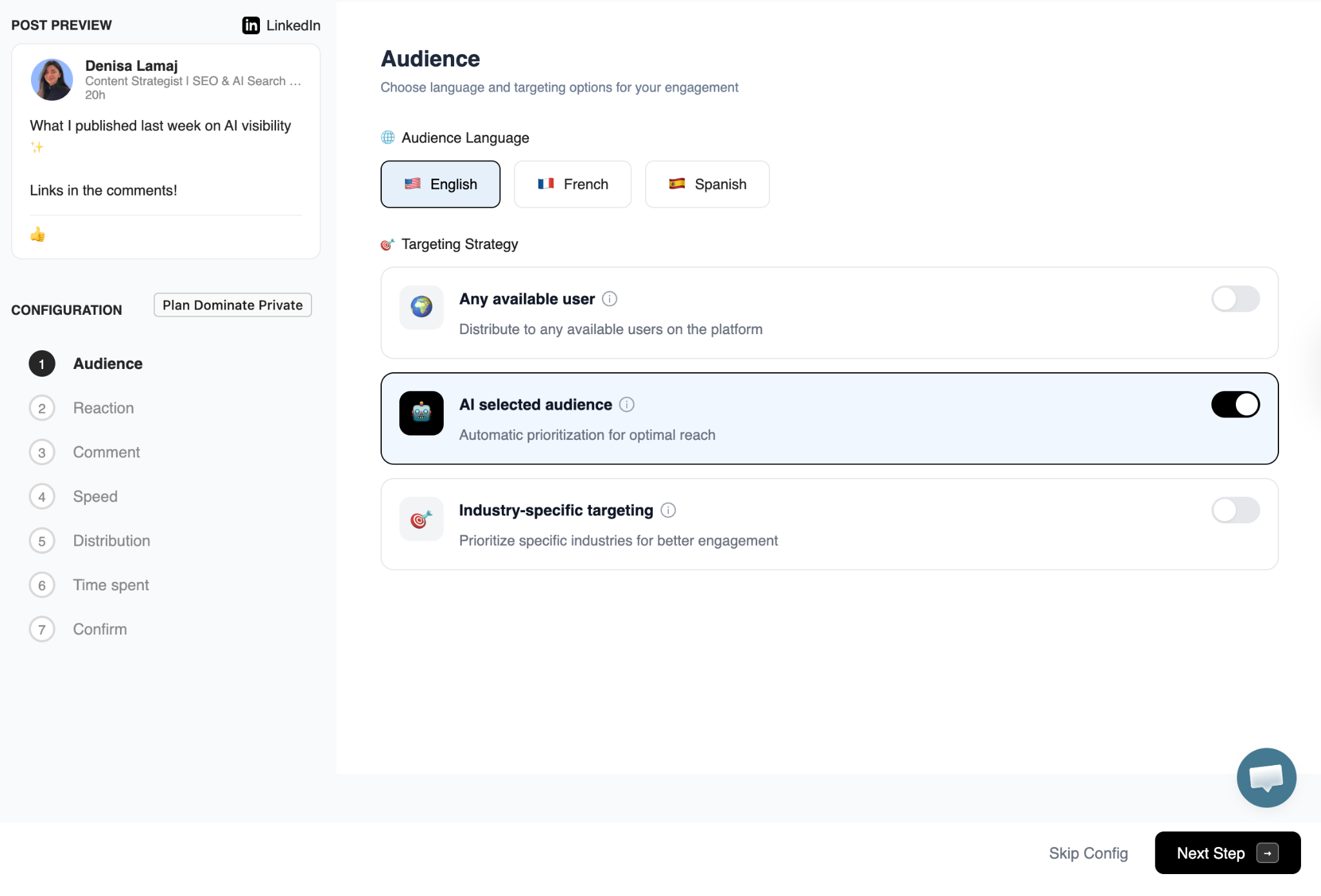
Reaction volume, with explicit risk labels. Up to 20 or 50 likes is labeled Safe. Up to 100 is labeled Risky. Up to 250 is labeled High Risky. You see the label before you choose. Most pod tools don't surface this at all. You find out the hard way, usually months later when you're trying to figure out why your reach collapsed.
Delivery speed. This is the variable that does the most damage when it's wrong. Getting 80 likes in 15 minutes looks nothing like organic behavior.
The options here run from Natural Growth mode (spread over 24 to 48 hours, labeled Safe Mode) to Standard Delivery (1 to 6 hours, Recommended) to Super Fast mode (under 1 hour, labeled Aggressive). Each label tells you exactly what you're trading off.

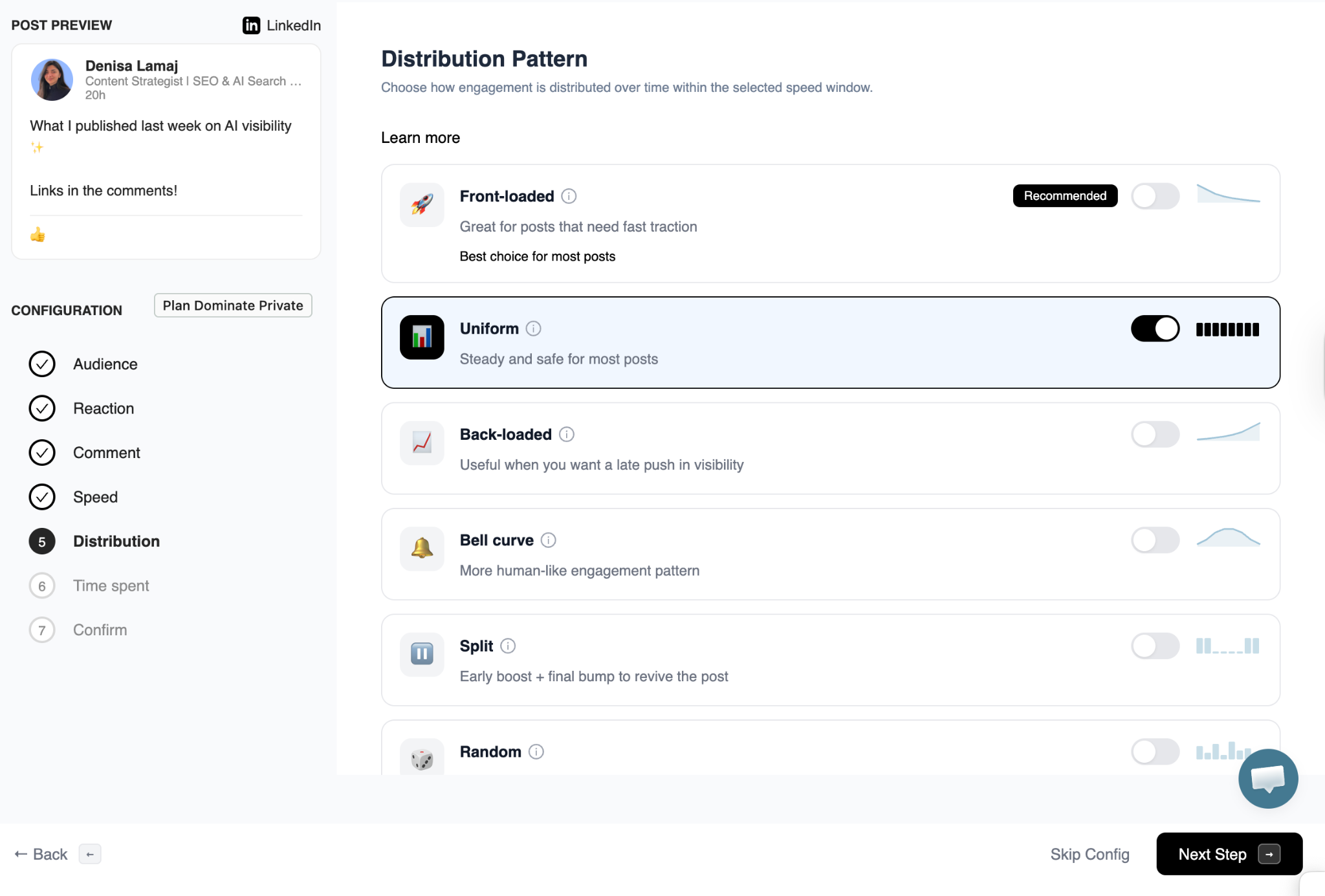
Distribution pattern. Beyond speed, you can control the shape of engagement over time: front-loaded for posts that need early traction, bell curve for more human-like activity, uniform for steady spread.
The pattern changes what the engagement timeline looks like to LinkedIn's system.
Time spent on post. Aside fromBeyond likes, the tool can simulate actual visits at realistic reading durations: a quick glance, normal reading time, or deep reading between 2 and 3 minutes. Dwell time is a real distribution signal. This setting lets you send it alongside reactions.
The point of these filters is that you're making informed tradeoffs instead of blind ones, which helps you produce very different long-term outcomes.
So, Are LinkedIn Pods Safe?
Short term: generally yes, if you stay within a realistic volume and timing.
Long term: it depends entirely on how you're using them.
Generic pods with no audience targeting, high volume, and instant delivery will quietly erode your reach over time. Not because of a direct penalty.
Because the signals you're building don't point anywhere useful, and LinkedIn's algorithm learns from those signals continuously.
Configured pods, with relevant audience targeting, controlled delivery speed, and realistic volume, can drive early traction without distorting your distribution data.
If your goal is actually growing your LinkedIn presence rather than just accumulating likes, the path forward is understanding your metrics and building engagement that teaches LinkedIn the right things about your audience. The guide on how to get more followers on LinkedIn covers that in detail.
Key Takeaways
- Pods work early. The same group liking every post is where it starts breaking down
- The real danger isn't getting banned. It's six months of fake momentum with nothing to show for it
- LinkedIn is watching who engages, not just how many. Same faces every time = shrinking reach
- Three settings determine whether pods help or hurt you: who sees your post, how fast, and how many likes you're asking for
- LinkedIn is getting stricter. Configured engagement is no longer optional, it's the difference between pods working and pods backfiring
If you're going to use pods, do it with full visibility. Try Podawaa!
Frequently Asked Questions
Can LinkedIn detect pods?
LinkedIn's VP of Product Management confirmed the platform is working to reduce visibility for content showing signs of coordinated artificial engagement. LinkedIn hasn't confirmed a system that detects specific named tools. What it evaluates are behavioral patterns: same accounts engaging every time, tight timing windows, low audience relevance. Those patterns reduce distribution value regardless of which tool produced them.
How many likes is too many?
It depends on your account's organic engagement baseline. A post receiving 200 pod likes when your average organic engagement is 8 sends a disproportionate signal. Tools that label volume tiers explicitly by risk level are calibrated around what's proportionate for typical accounts at different baselines.
Does it matter how fast the likes arrive?
Yes, significantly. Fifty likes arriving gradually over 24 hours looks completely different from 50 likes in 15 minutes. Delivery speed is often the variable that tips an otherwise reasonable engagement setup into territory that limits distribution rather than supporting it.
What's the most important setting to get right?
Audience relevance. You can control timing and volume carefully, but if the accounts engaging with your content have no real connection to your industry or topic, the distribution signal still points in the wrong direction. LinkedIn uses who engages to understand who your content is for.