Your LinkedIn About section doesn't have to read like a traditional professional bio. Some of the best ones I've found use a short list, a career timeline, a mini-story, or even just a few numbers.
I collected 9 real LinkedIn About section examples from founders, creators, marketers, engineers, and job seekers and broke down what each one does well.
You'll also see when each format works best, so you can choose one that fits your own profile instead of copying someone else's About section.
What Makes a Good LinkedIn About Section?
After looking at these LinkedIn About sections, here is what I found:
- Your first 1–2 lines matter most. Use them to say what you do, what you’re looking for, or what makes you different.
- You don’t need to write a traditional bio. Lists, timelines, mini-stories, and even a few strong results can work better than long paragraphs.
- Specifics beat descriptions. “$9.2M+ in revenue” says more than “successful entrepreneur.” The same applies to clients, audience size, projects, and career results.
- Write for the person visiting your profile. A founder selling a service needs a different About section from a job seeker trying to get noticed by recruiters.
- Make your profile easy to read. Short paragraphs, bullets, numbers, and clear sections help people understand your profile quickly.
- Tell people what to do next. That might be sending a DM, booking a call, checking your work, following you, or simply knowing that you're open to a new role.
How I chose these examples:
I looked for real LinkedIn profiles using different approaches to their About sections, from founders and creators to engineers, consultants, and job seekers with followers from 3K to 200K.
I prioritized examples that were specific, easy to read, and gave us something useful to learn from rather than simply collecting 9 polished bios.
1. Personality-Driven About Section
Here's a good example of a LinkedIn About section that feels more like a personal introduction than a traditional professional bio:
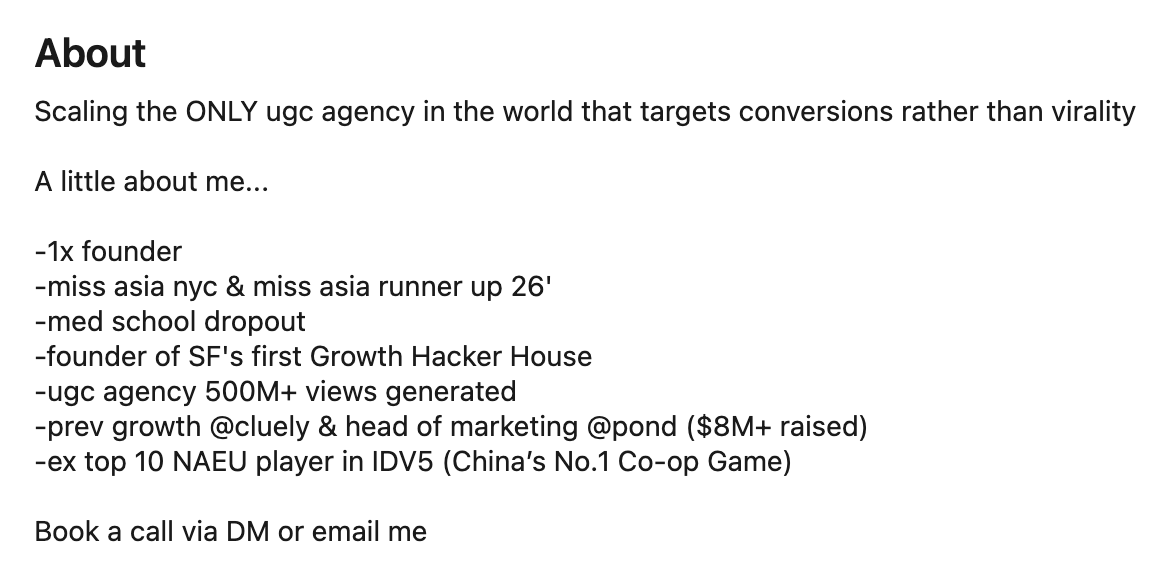
The opening line does most of the positioning work: “Scaling the ONLY UGC agency in the world that targets conversions rather than virality.”
In one sentence, she tells you what she does and what makes her agency different. If you're a founder, freelancer, or consultant, this is a useful structure you can use. Try opening with what you do + the specific result or approach.
Then she switches to a simple list. Instead of explaining her career chronologically, she mixes business proof with details you probably wouldn't find on a résumé: founder experience, previous growth roles, dropping out of medical school, and even a competitive gaming rank.
That's what makes this format work well for founders and marketers building a personal brand. Your About section doesn't have to document your entire career. You can choose a few details that quickly show your expertise and give people something to remember you by.
The CTA is just as direct: “Book a call via DM or email me.” If your LinkedIn profile is designed to generate leads, ending with one clear action is enough.
Try this format if: you're a founder, freelancer, consultant, or creator and want your About section to show both credibility and personality.
2. Mini-Story About Section
This agency founder turns his About section into a very short business story built around one contrast.
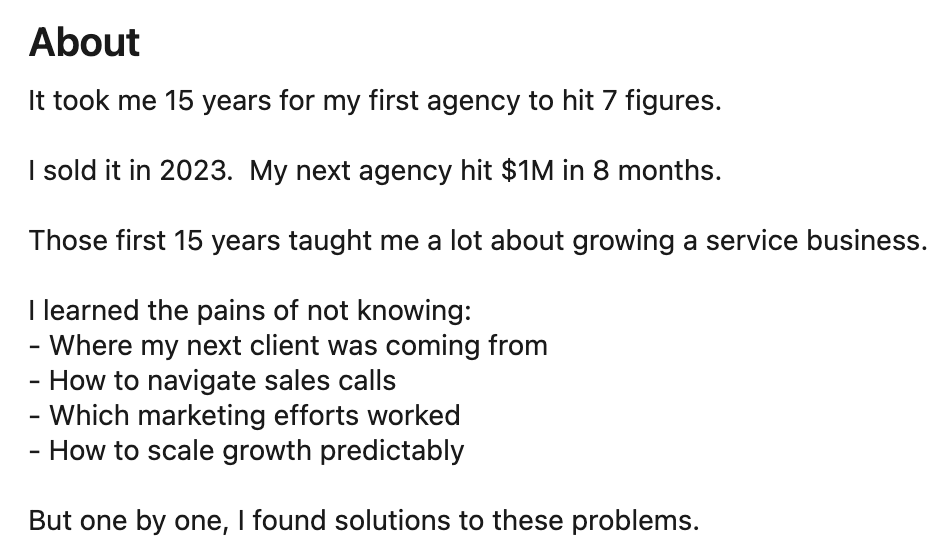
The first two lines do most of the work: “It took me 15 years for my first agency to hit 7 figures. I sold it in 2023. My next agency hit $1M in 8 months.”
15 years vs. 8 months immediately gives the story a before and after. More importantly, those numbers provide proof. He doesn't have to tell you he's become better at building agencies. The difference in results shows it.
He then explains what happened during those 15 years by naming four problems he had to solve:
- finding the next client
- navigating sales calls
- knowing which marketing efforts worked
- scaling growth predictably
This is smart because those aren't random lessons from his career. They're the same problems his target audience is likely trying to solve.
The final line, “One by one, I found solutions to these problems,” positions him as someone who has worked through these challenges himself, without turning the About section into a sales pitch.
Try this format if: you have a clear before-and-after result in your career or business. Lead with the contrast, then explain the problems you had to solve to get from point A to point B.
3. Ultra-Short About Section
This health-tech founder skips the traditional bio. Her About section is basically a current role, one memorable fact, and a short career history.
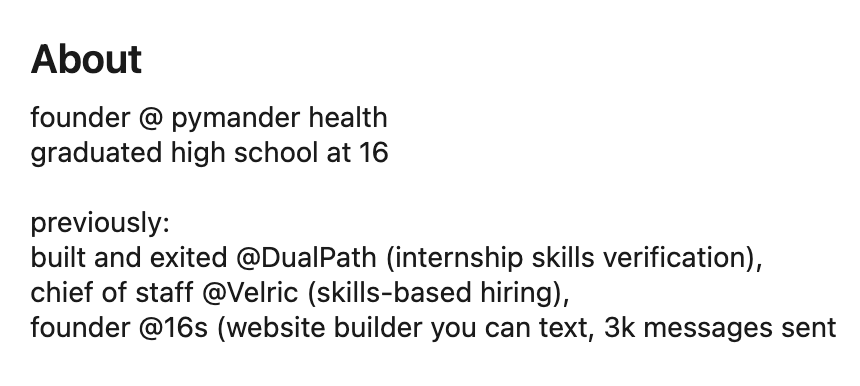
She starts with just two lines: “founder @ pymander health” and “graduated high school at 16”
The first tells you what she's doing now. The second gives you something you're much more likely to remember about her. There's no introduction needed before either one.
Then she uses “previously:” to turn the rest into a compact proof-of-work section. Each role gets a tiny bit of context, such as “skills-based hiring” or “website builder you can text,” so even someone unfamiliar with those companies can understand what she worked on.
That's what makes the format work. It's short without being vague. You still learn what she does, what she's built, the areas she's worked in, and one unusual detail about her.
Try this format if: you already have a few specific roles, projects, companies, or results that can speak for themselves. Start with what you're doing now, add one memorable detail, then use a short “previously” list for the proof.
4. Expertise-Led About Section
This other example takes a different approach. Instead of telling a career story, it makes the person's area of expertise immediately clear.
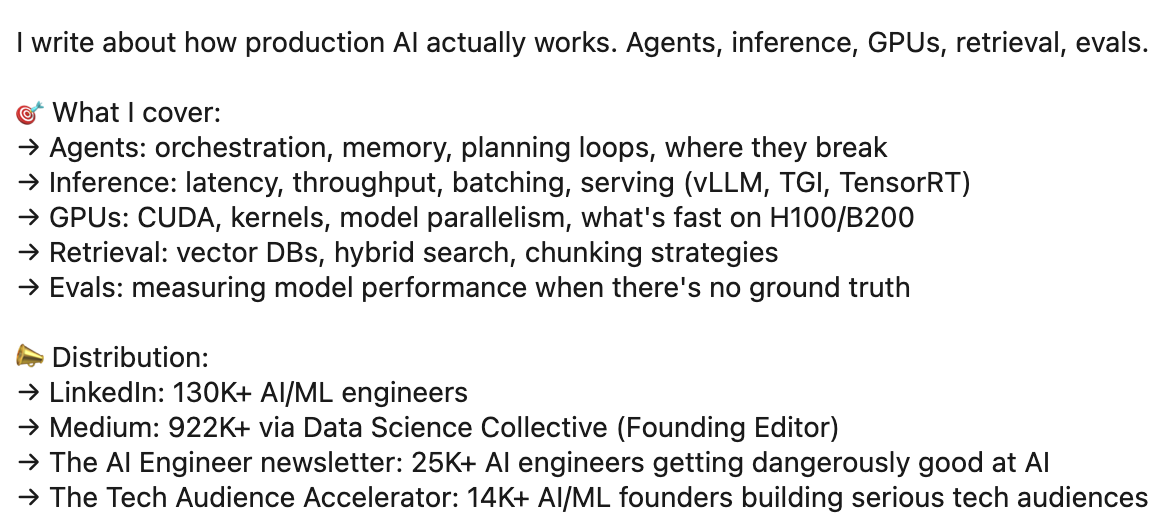
The opening sentence tells you exactly what you'll get from following him: “I write about how production AI actually works.”
Then he gets much more specific. Instead of simply listing broad topics like AI, agents, and GPUs, he breaks each one into the subjects he actually covers:
- Agents → orchestration, memory, planning loops
- Inference → latency, throughput, batching
- GPUs → CUDA, kernels, model parallelism
- Retrieval → vector databases, hybrid search, chunking
- Evals → measuring model performance
That specificity is what makes the expertise convincing. “I write about AI” could describe thousands of LinkedIn creators. “I write about inference latency, CUDA kernels, and retrieval strategies” tells you exactly what he knows and who his content is for.
The second half adds proof through distribution. He doesn't just say that he has an audience. He gives the numbers: 130K+ AI/ML engineers on LinkedIn, 922K+ through Data Science Collective, and 25K+ newsletter readers.
So the structure is very simple: expertise first, proof second.
And importantly, he doesn't simplify the terminology for a general audience. If you're an AI engineer, terms like inference, CUDA, or vector databases immediately tell you that the profile is relevant to you.
Try this format if: you create content around a specialized topic and want your LinkedIn profile to attract people already working in that field. Name the specific subjects you cover, then back that expertise with measurable proof where you have it.
5. Open to Work About Section
This example is from a content marketer looking for a new role.
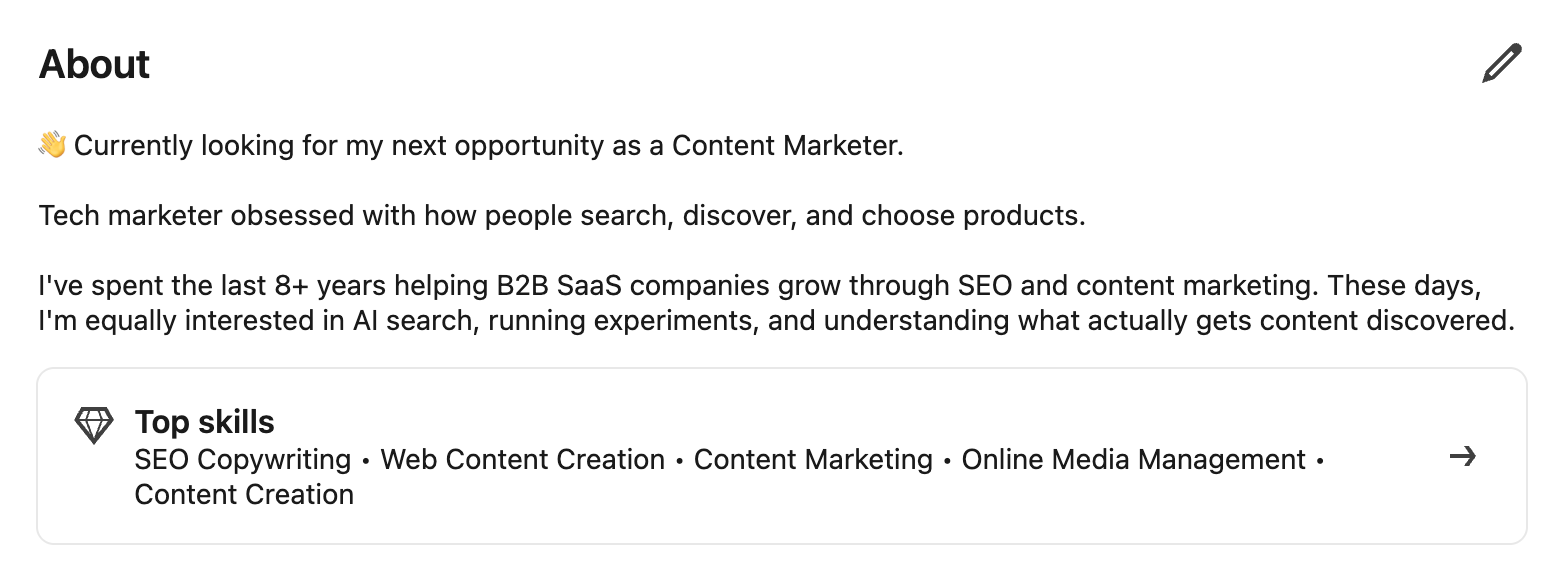
The opening is doing most of the work: “Currently looking for my next opportunity as a Content Marketer.” A recruiter doesn’t have to infer whether this person is available or what type of role they want.
This is also a useful alternative if you don’t want to use LinkedIn’s Open to Work photo frame. You can communicate the same intent directly in your About section while keeping your profile photo unchanged.
What makes it stronger than simply writing “open to opportunities” is the specificity. It names the target role, Content Marketer, and then immediately follows with positioning: “Tech marketer obsessed with how people search, discover, and choose products.” So the reader gets both availability + expertise within the first two lines.
You could adapt the same structure to almost any role:
- “Currently looking for my next opportunity as a Product Designer.”
- “Looking for my next role in B2B SaaS content.”
- “Currently exploring Software Engineering opportunities in fintech.”
Try this format if: you’re actively job hunting and want recruiters or hiring managers to understand what you’re looking for as soon as they land on your profile.
6. Career Timeline About Section
This founder skips the traditional career bio and turns his About section into a timeline, with each line covering one milestone.
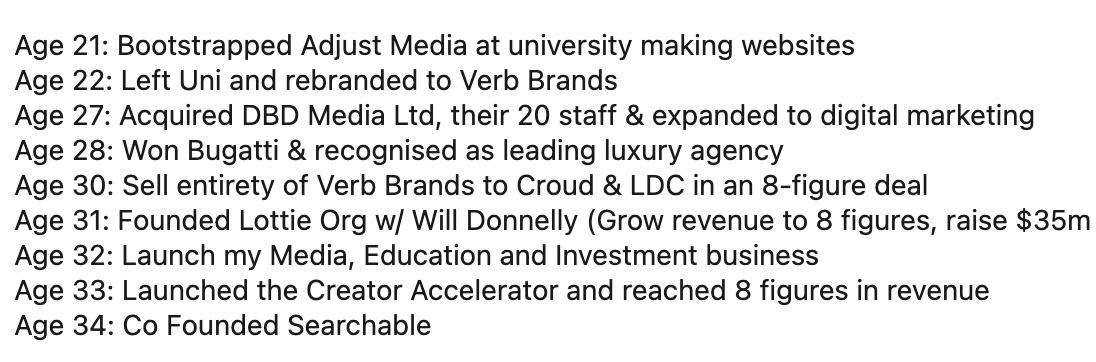
Every line follows the same structure: age + milestone.
“Age 21: Bootstrapped Adjust Media…”
“Age 27: Acquired DBD Media…”
“Age 30: Sell entirety of Verb Brands…”
That repetition makes a long career much easier to read. Even if you skim the section, you can still see how he went from starting a company at university to completing acquisitions, making an eight-figure exit, raising funds, and launching new ventures.
He also only includes milestones that move the story forward. There are no job descriptions or explanations of what happened between ages 21 and 27, for example.
The numbers make those milestones more concrete too: 20 staff, an eight-figure deal, $35 million raised, eight figures in revenue. Instead of describing each business as successful, he gives you enough information to judge the scale yourself.
Try this format if: you have several clear milestones across your career. Pick the moments that changed your trajectory, attach a year or age to each one, and use numbers where they add useful context.
7. Mission-Led About Section
This Engineering Manager and co-founder starts with the reason behind his work before explaining his roles or accomplishments.
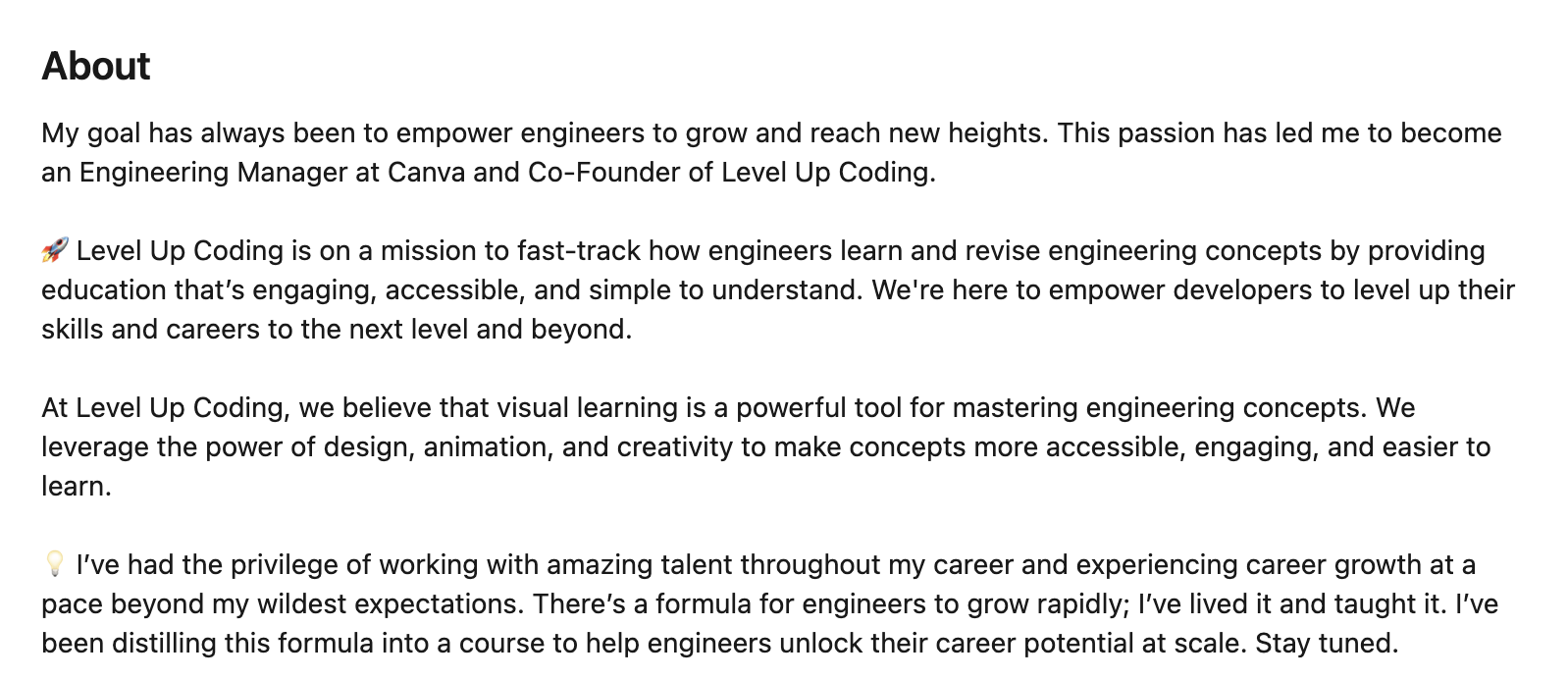
He opens with the purpose behind his work rather than his job title: “My goal has always been to empower engineers to grow and reach new heights.”
This gives readers one clear idea that connects everything he does. When he later mentions being an Engineering Manager at Canva and co-founder of Level Up Coding, those roles support his mission instead of reading like a list of credentials.
The rest of the About section follows the same idea. He explains what Level Up Coding does, how it approaches engineering education, and then connects that work back to his own experience helping engineers grow.
The emojis also have a practical purpose. 🚀 introduces the company and 💡 introduces his personal experience, breaking a long About section into sections you can scan quickly.
The final paragraph then moves from what he's already done to what he's building next: a course based on the career-growth framework he says he has used and taught. “Stay tuned” works as a simple CTA. It gives people a reason to follow what comes next.
Try this format if: your job, company, content, and side projects all connect to one bigger mission. Start with that mission, use your current work as proof, then finish with what you're building or working toward.
8. Service-Based About Section
This one is from a brand and content strategist, and unlike the previous examples, the About section works almost like a mini services page.
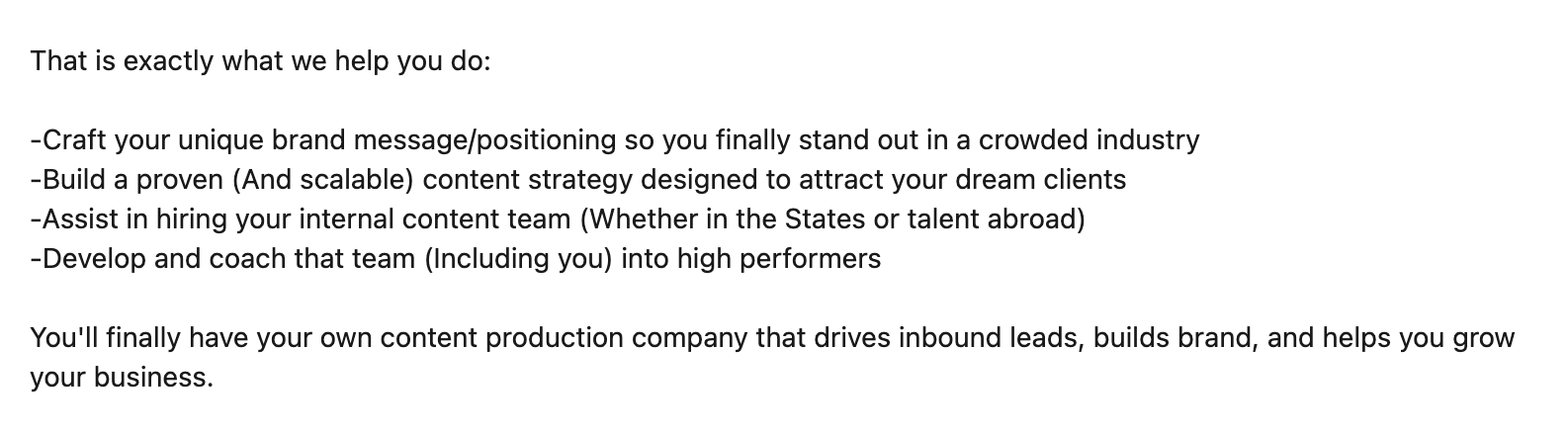
The strongest part is how the offer is structured. Each bullet starts with an action: craft, build, assist, develop. Instead of listing what the writer is good at, the bullets explain what they will actually do for the client.
Compare “build a proven (and scalable) content strategy” with something generic like “experienced in content strategy.” The first tells a potential client what they can hire you for. The second only describes a skill.
The bullets are also specific enough to show the scope of the service. This person isn't simply providing “content strategy.” They can help with positioning, strategy, hiring a content team, and coaching that team.
Then the final sentence shifts from what they do to what the client gets: a content operation that generates inbound leads, builds the brand, and supports business growth. That gives the section a simple structure:
- Services: what I'll help you do
- Scope: what that work includes
- Outcome: what you should get from it
Try this format if: you're a freelancer, consultant, agency owner, or service provider using LinkedIn to generate leads. Your About section can work as a short offer page instead of telling your entire career story.
9. Results-Driven About Section
This example skips the career story completely and leads with five numbers that show the size of the business and audience.
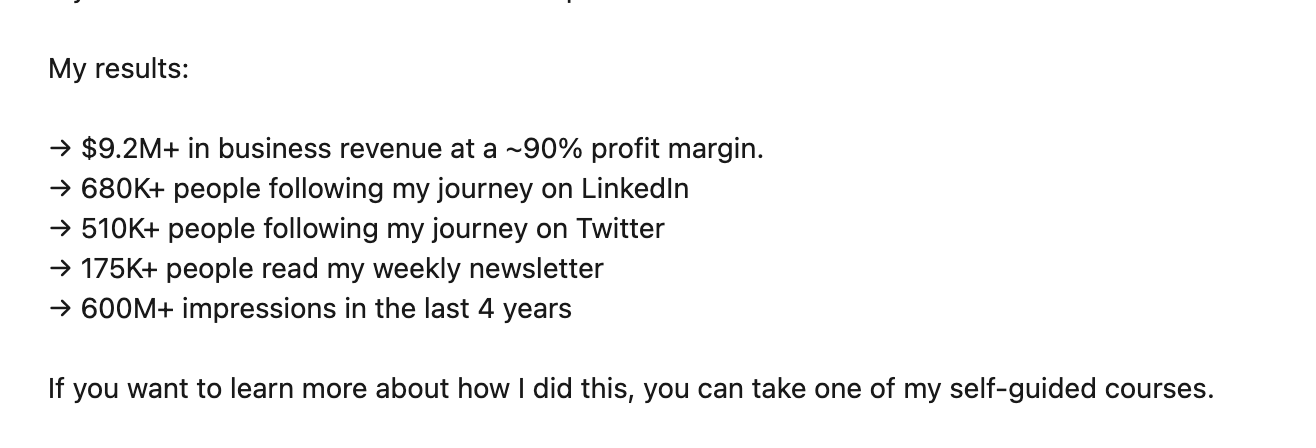
The first number is the strongest business result: “$9.2M+ in revenue at roughly a 90% profit margin”. Starting there immediately establishes that the person has built the kind of business they're now teaching others about.
The next three numbers prove audience size across LinkedIn, X and the newsletter. Then 600M+ impressions adds a broader reach metric. In five bullets, you get three different kinds of proof:
- Business: $9.2M+ revenue and ~90% profit margin
- Audience: followers and newsletter subscribers
- Reach: 600M+ impressions
That mix is more convincing than filling the section with claims like “experienced creator.”
The CTA also follows naturally from the proof: “If you want to learn more about how I did this…” The courses are positioned as a way to learn the process behind results the reader has just seen.
Try this format if: you already have strong, specific results you can quantify. It works especially well for founders, consultants, creators, and anyone selling expertise based on something they've already achieved.
LinkedIn About Section Template
Use this as a starting point, then adapt it to your experience and what you want people to do after visiting your profile.
[What you do + who you help]
[1–2 sentences about your experience, current role, or how you got here.]
[Specific result, project, client, or achievement]
[Optional personal detail that makes the section sound like you.]
[What you're doing now + what you want the reader to do next]
You don't need every part. As the examples above show, a strong LinkedIn About section can be a story, a list of results, a career timeline, or just a few lines.
Turn Your LinkedIn About Section Into Posts
Your About section explains what you do after someone visits your profile. Your posts give them a reason to visit it in the first place.
Once your About section is ready, highlight three things from it:
- An area you know well
- A result or project you’re proud of
- An opinion or lesson you can share
Each one can become a LinkedIn post. For example, if your About section says that you help companies grow organic traffic, you could write a case study about a result, a how-to post explaining your process, or an opinion about an SEO trend.
If you need an angle, Podawaa has hundreds of free LinkedIn templates organized into formats such as Case Study, Story, How-to, Opinion, and Expertise.
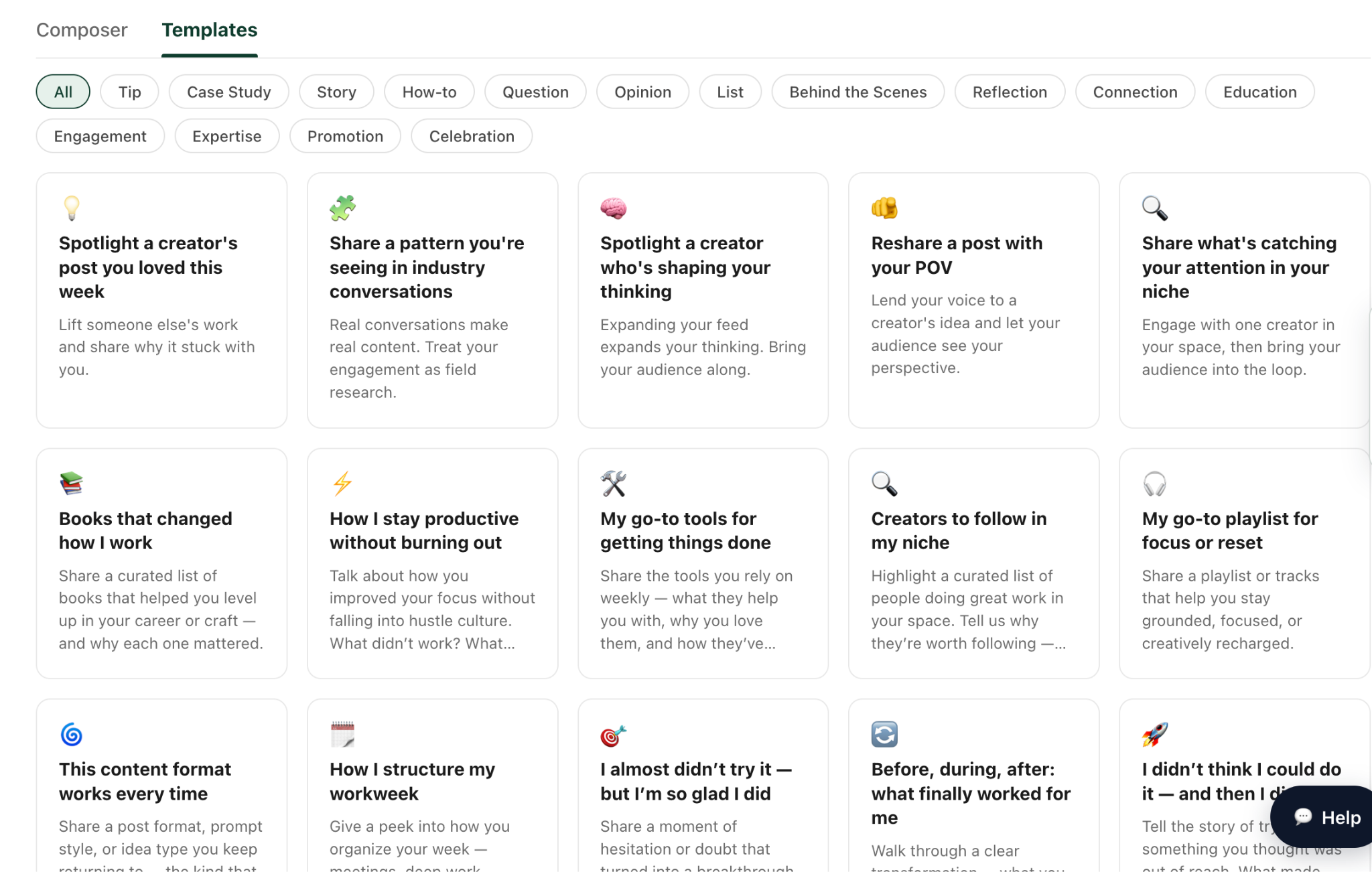
Choose your first template and turn something from your About section into a post today. You can then prepare the rest of your ideas and schedule them in your Podawaa calendar.
FAQs About LinkedIn About Sections
Is the LinkedIn About section the same as a LinkedIn summary?
Yes. About section is LinkedIn's current name for the profile section that is also commonly called a LinkedIn summary.
How long should a LinkedIn About section be?
A LinkedIn About section has a hard limit of 2,600 characters, or roughly 370 to 450 words, depending on your word length and formatting.
However, that is the limit, not the target. Some of the examples above work in three lines, while others need several short sections. Write enough to explain what you do, provide relevant proof, and tell the reader what to do next. If a sentence doesn’t help with one of those things, you probably don’t need it.
Should I write my LinkedIn About section in first or third person?
First person is usually the better choice for a personal LinkedIn profile. It makes the section feel like you're introducing yourself directly rather than having someone else write your bio.
How often should I update my LinkedIn About section?
Update it whenever your positioning changes. A new role, major result, new service, career change, or active job search are all good reasons to revisit it.
Do I need an About section if my experience is already on my resume?
Yes. Your resume documents your experience, while your LinkedIn About section gives you space to explain what you do, what you're good at, what you've achieved, and what you're looking for in your own words.
What should job seekers put in their LinkedIn About section?
Job seekers should make their target role clear, add relevant experience or results, and include the keywords recruiters are likely to associate with that role. If you're actively searching, you can also say so directly in the opening lines.