
Fast engagement can boost your LinkedIn reach significantly. What limits it is when that engagement comes from the same narrow group every time, arrives all at once, and then stops completely.
At Podawaa, we see this pattern consistently across thousands of posts. The accounts that build stable, growing reach share one thing: their engagement looks like genuine discovery: varied audience, natural timing, continued interaction after the initial window.
In short: LinkedIn reads who is engaging, whether they're relevant, and whether engagement continues. Speed is just the context in which those signals arrive.
How LinkedIn Decides Whether to Expand Your Post's Reach
LinkedIn rewards early engagement. A post that picks up genuine reactions quickly gets tested on a wider audience. That's why the first hour on LinkedIn matters more.
Only about 1% of LinkedIn users post consistently enough to build a recognizable engagement pattern. If you're one of them, LinkedIn's algorithm is actively learning from every post: who engages, how fast, and whether it's the same group every time. That learning shapes how your next post gets distributed before you've written it.
From what we observe at Podawaa, the accounts with the strongest impression growth aren't the ones only with the most likes.
They're the ones getting engagement from relevant professionals, people who actually work in their field, even hours after the post goes live.
Our LinkedIn impressions case study shows what that distribution curve looks like compared to accounts where engagement spikes immediately and then stops.
What LinkedIn Actually Reads Beyond Early Engagement
LinkedIn processes four signals simultaneously on every post.
Who engages. LinkedIn algorithm decide what your content is about and who else should see it. Reaching the right audience on LinkedIn matters more than reaching a large one. 100 relevant engagements beat 1,000 random ones every time.
How many different people engage. If the same group shows up on every post, LinkedIn treats your content as relevant only to them. New faces signal broader appeal and push distribution further.
Diversity suggests genuine interest. Repetition tells LinkedIn you have a closed network.
What type of engagement it is affects distribution weight. Saves and shares indicate someone found the content genuinely valuable.

Our LinkedIn saves and sends guide explains why LinkedIn weighs these signals differently from reactions and what that means for your reach.
How long engagement keeps coming. A post that keeps getting interactions hours after publishing tells LinkedIn people are still discovering it
At Podawaa, we've found that Natural Growth delivery (spreading engagement over 24 to 48 hours) consistently produces more stable impressions than faster delivery modes, precisely because that continued signal gives LinkedIn reason to keep testing the post on new audiences.
Why Engagement Timing Affects Your LinkedIn Distribution
LinkedIn treats the pace of engagement as proof of genuine interest. When all engagement arrives in one compressed window, it looks coordinated rather than organic.
LinkedIn tests the post on a small group, sees the spike, sees engagement drop to zero, and concludes the content has no broader appeal. Distribution stops.
Real audiences don't all see a post at the same moment. Organic engagement arrives as different people scroll at different times, from different locations, across different time zones.
At Podawaa, we label Super Fast delivery (under 1 hour) as Aggressive in the interface. Not to scare users, but because the data shows that compressed window consistently limits how far posts distribute afterward.
If you're wondering whether LinkedIn can identify this pattern specifically, can LinkedIn detect engagement pods? answers that directly.
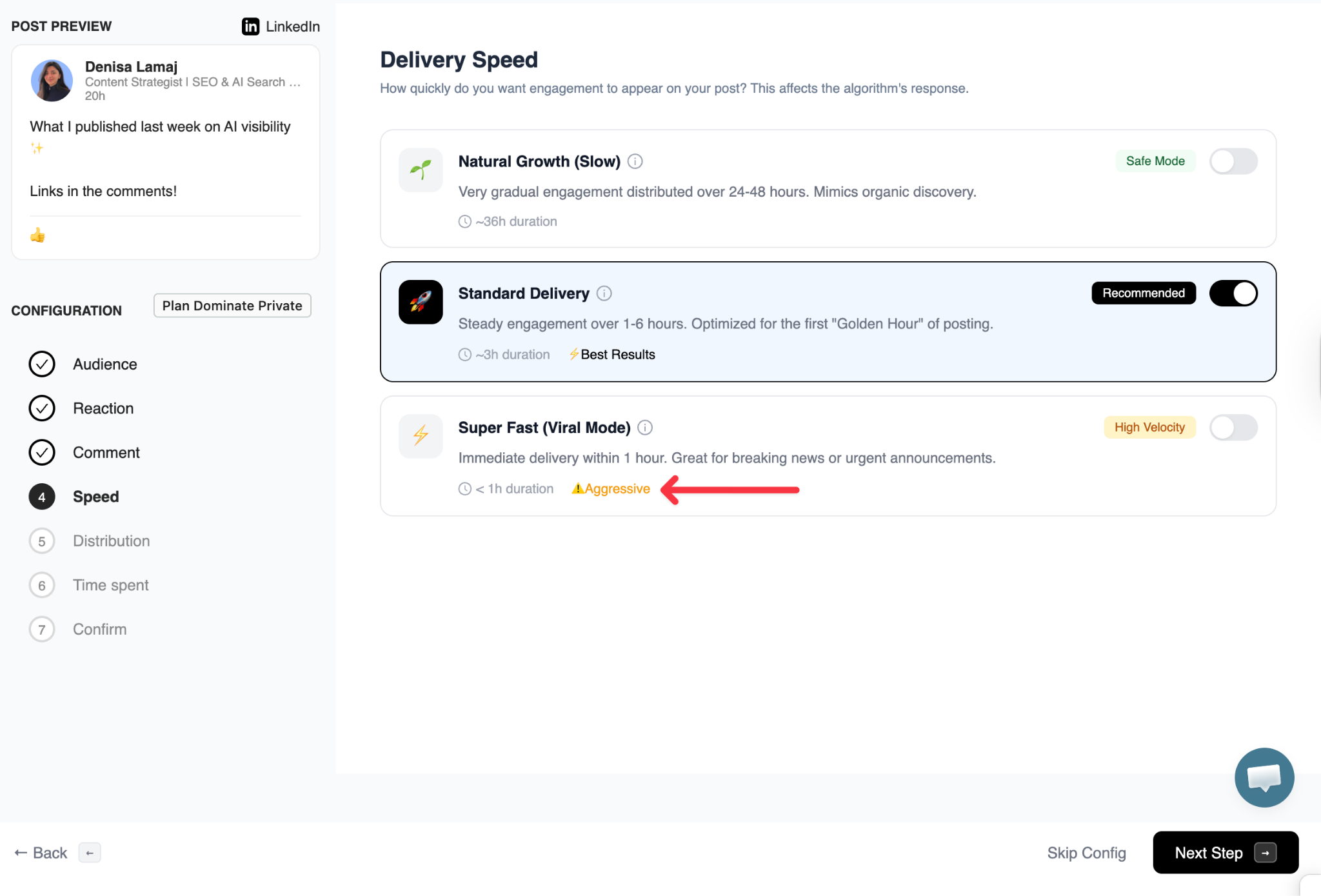
Standard Delivery over 1 to 6 hours, optimized for the golden hour after publishing, produces the best results for most posts. Natural Growth over 24 to 48 hours works best for accounts focused on long-term distribution.
Aside from speed, the shape of engagement matters too. A bell curve pattern, where interactions build gradually then taper, tends to look more like organic discovery than a front-loaded spike that drops off immediately.
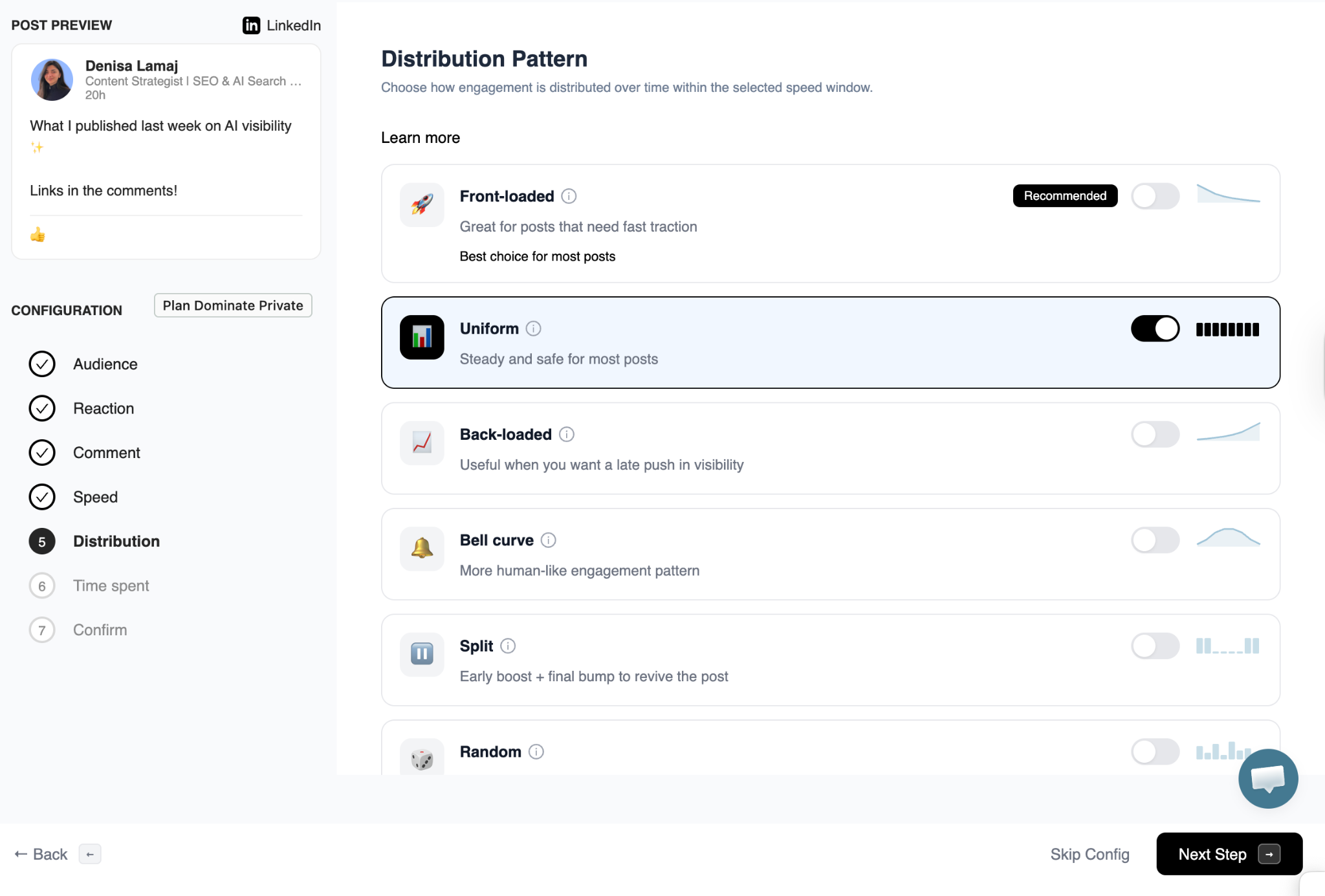
Front-loaded works for posts that need fast traction. Uniform spread keeps interactions steady throughout the window. Each pattern produces a different signal, and LinkedIn reads all of them.
How to Tell If Your Engagement Pattern Is Hurting Your Reach
Pull up your LinkedIn metrics for the last 28 days and check three things.
Impressions vs. reactions. Reactions holding steady while impressions decline means engagement isn't translating into reach. The likes are coming in. The distribution signal isn't working.
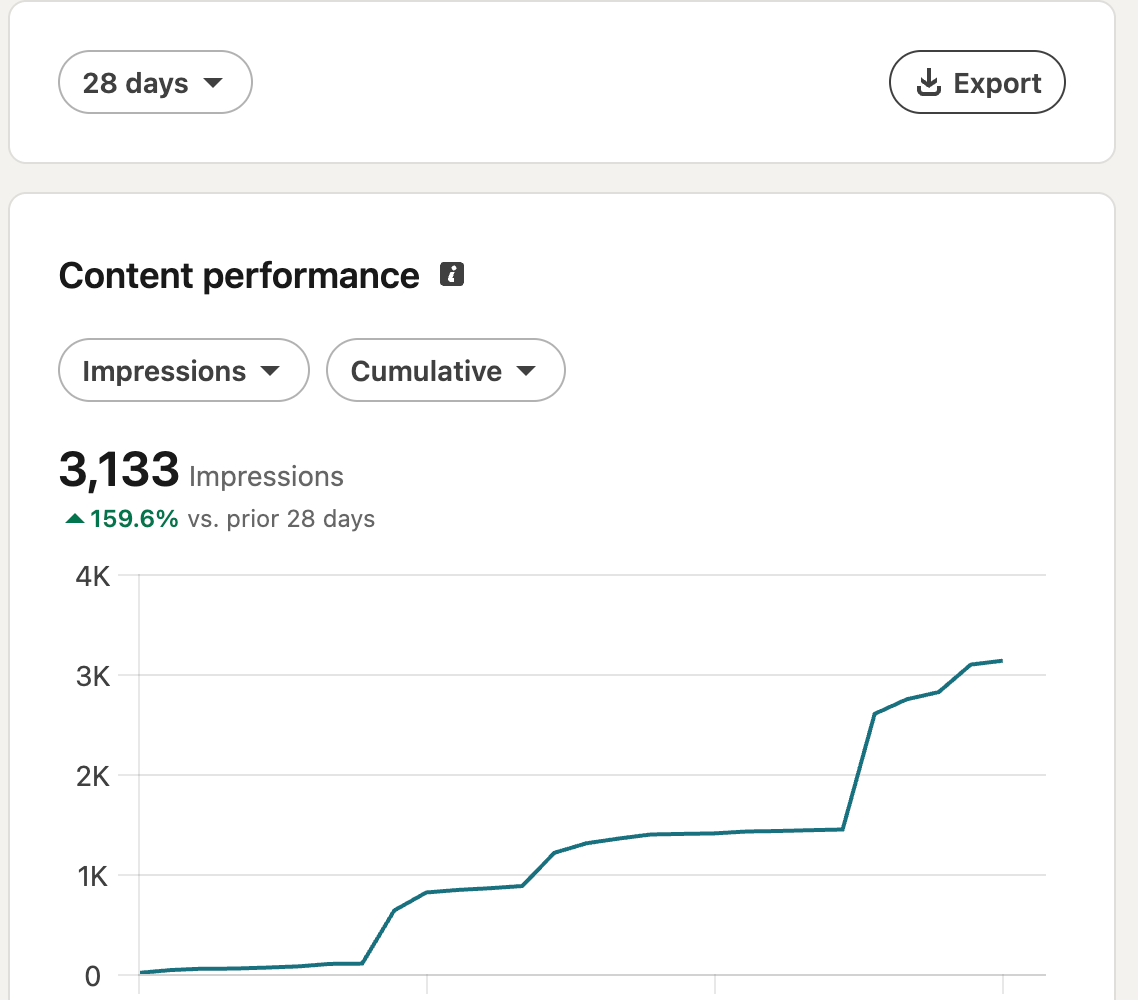
When engagement arrives per post. A spike in the first 20 to 30 minutes followed by silence is the pattern to look for. Engagement spread across several hours is healthier.
Who is engaging across your last five posts. If the same small cluster of job functions dominates repeatedly across different content topics, your engagement pool is too narrow.
If your engagement looks healthy but reach is still low, the problem might be elsewhere. Why your LinkedIn posts get no reach covers the other variables.
How to Improve LinkedIn Engagement Timing and Reach
Post when your real audience is online. Early engagement from people active at an off-peak hour won't match your target audience. Check LinkedIn Creator Analytics for when your followers are most active. The best time to post on LinkedIn covers this with data across industries.
Build genuine connections before you need them. Early comments from people in your industry are the highest-value first-hour signal. That comes from real relationships, not follower count.
Give each post enough space. Posting too often compresses engagement across too many posts and weakens the first-hour signal on each one. How often to post on LinkedIn covers what frequency actually produces better cumulative reach.
Configure engagement for spread, not just volume. Relevant audience, realistic timing, and continued interaction after the initial window. Those three variables determine whether your engagement looks like discovery or a closed loop to LinkedIn's system.
Key Takeaways
- LinkedIn rewards early engagement but reads the pattern behind it: who, how diverse, what type, and whether it continues
- Only around 1% of LinkedIn users post consistently enough to build a real engagement pattern, for those who do, the quality of that pattern determines reach
- Saves and shares signal genuine value and carry more distribution weight than reactions
- Engagement that arrives in a compressed window and then stops tells LinkedIn the content has no broader appeal
- The shape of engagement over time (bell curve, uniform, front-loaded) produces different signals, not just the speed
- Relevant audience and continued engagement after the initial window are the two variables with the highest impact on reach outcomes
Frequently Asked Questions
Is there a speed threshold that causes reach problems?
No published threshold exists. The issue is the combination of source repetition, timing compression, and engagement drop-off. Not a fixed number of likes per minute. 100 likes in 20 minutes looks very different on an account with 50,000 followers vs one with 800.
What if my post goes viral organically?
Organic viral engagement comes from diverse accounts and keeps growing as shares compound. A spike that continues spreading reads completely differently from one that dies immediately, even if the initial speed looks similar.
How long before I can tell if a post performed well?
Give it 48 to 72 hours. Some posts keep receiving engagement and impressions growth days after publishing, especially after getting shared into new networks. Judging after a few hours gives you an incomplete picture.
Does commenting on my own post right after publishing help?
A substantive comment immediately after publishing can seed discussion and gives the algorithm something beyond reactions to read. Keep it useful, a question, follow-up context, or a specific example. Small positive signal, not a significant lever on its own.
Does this mean engagement pods are always bad?
No. Untargeted engagement delivered all at once from the same group limits distribution. Configured tools that control audience relevance, delivery timing, and engagement shape can produce signals that support reach rather than limiting it. Are LinkedIn pods safe covers how configuration changes the outcome.